Praying, Packing and Planning

Planning

Countdown to departure for Uganda: T-8 days

This thing is getting real. I’m totally funded (praise the Lord!), and both my biological and church families are strongly behind me. I am SO grateful. My church had a blast hosting a fundraiser at Culver’s last week for me and a number of other folks who will be traveling as missionaries this summer. I’m getting to know my team better and I’ve purchased much of what I need to take with me. We’re closing in on being ready to rock. All in all, the run-up to my departure has been pretty exciting and a blessing to me. I started out pretty nervous, but the closer I get, the more excited I am.

At any rate, I thought it was about time to spend a little of my Sunday afternoon giving y’all an update. I’ll focus on three areas…

Prayer

Praying Hands over ScripturePlease pray for me, for my family and for the trip. I wanted to share a few prayer requests God has placed on my heart, and ask you, if you feel led, to support us in prayer.

  1. Please pray that the gospel would go forth in power. While in Uganda, I will be meeting with Christians and non-Christians, as well as secular and believing students and professors. I’ll be preaching in churches and engaging in any number of conversations on campus, in the marketplace, in homes, in cafes, etc. Please pray that the gospel would be proclaimed, that the Lord Jesus would be clearly visible, and that the Spirit would give me (and the others with me) the words to say and the hearts to act when the time comes.
  2. Please pray for my sermon prep. I’m planning two messages, one from Colossians 1 and the other from Revelation 19. I will likely be called upon to preach one or both of them while there. Please pray for the prep, the delivery, and the follow-up. I plan to post the manuscripts when they’re done, btw, in case you’re interested.
  3. Please pray for health. I’ve been exposed to so much discussion about possible illness and all the crazy bugs that live in a place like Uganda that don’t live here. Therefore, sometimes I’m tempted to stress a bit about it. It’s an ongoing journey to keep giving that to the Lord, so please pray for continued health and for that struggle.
  4. Please pray for my family. I’m going to be gone for awhile (16 days). It will definitely create some struggles for Faith and John for me to be gone for that long. Please pray for them, including schedule juggling, meal prep, homework assistance, and all the other practical stuff that tends to get a lot harder when one parent is working on them instead of two.
  5. Pray for a sense of God’s heart. The primary function of this trip is to open ourselves up to learning what God has in mind for my family and our ministry — to discern if God would have me teach or preach in another part of the world. Going to Uganda is, primarily, to investigate that. Please pray with us that God would speak clearly to us so, and that we would be open to whatever He says: anything, anywhere.

Thank you so much for your prayers! I can’t tell you how much it means to us to have so many supporting and praying for us.

Packing

Jimmy Stewart Big SuitcaseSo, it appears packing for this trip might be slightly more involved than the average business trip has been. I know, I know … a phenomenal command of the obvious, right? So in addition to throwing the standard toiletries bag in a carry-on and counting pairs of socks and underwear, I’m evidently going to need heavy-duty, specialized gear for fending off the blazing desert sun and promised swarms of bird-sized mosquitos eager to remove my arm and take it back to feed their young. Supposedly, they laugh at clothing, drawing blood right through anything but chainmail, etc. Plus, there’s the need to plan several, diverse modes of dress for an even more diverse range of activities.

What will we be doing?

Here’s the spectrum of activities:

  • Preaching / teaching in church
  • Engaging students and professors on campus
  • Hiking in the mountains
  • Visiting in homes and cafes
  • Touring in the city
  • Sleeping … in the bug free environment I can possibly establish. <cringe>

What are the conditions?

The (very) good news is that laundry facilities will be available. (Happy dance!)

The not-as-great news is that the equator literally runs through the nation of Uganda, so the direct blazing sunlight doesn’t really get much more direct or blazing anywhere else on earth. And I’m a blonde, fair skinned German. Sigh.

Second bunch of well-heated awesome is the expectation that “proper, respectful attire” is all about covering skin. So preaching in shorts and a Hawaiian pineapple shirt is pretty much out. At least the jeans and slacks will create an impenetrable barrier against the super-bugs. Oh wait.

Then there’s the air conditioning… Yeah, that doesn’t exist.

All joking aside, I think the one thing about this trip that scares me is the heat. So, we should add that to the prayer requests.

Given all that, how should I pack?

Well, TIU shared an extremely helpful, valuable list to get me started. And I’ve built on that. Here’s the packing list I’m currently working with:

  • Passport, immunization records, cash and medications
  • Toiletries (in carry-on, along with one day of clothing and the stuff to make layovers less horrendous, just in case)
  • Bible — With some key passages marked
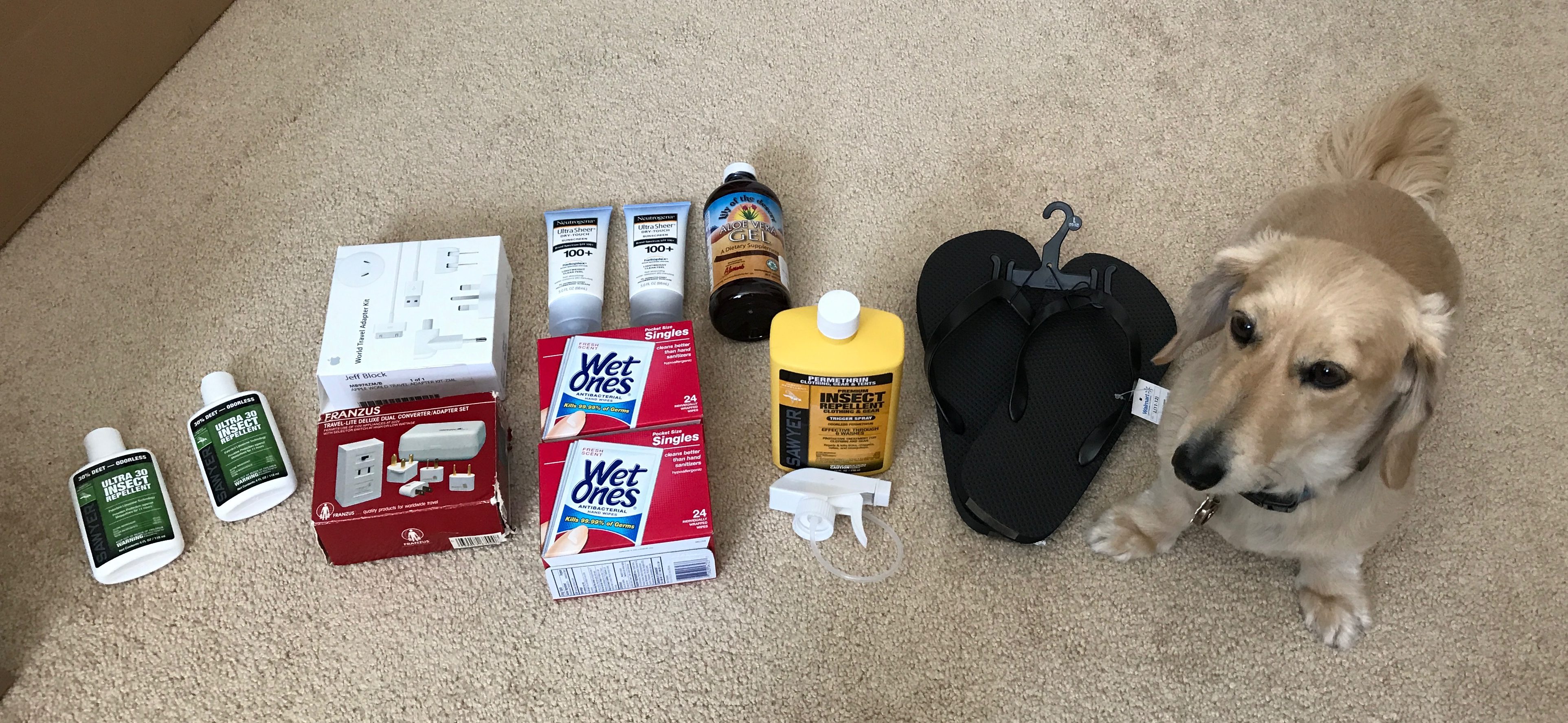
  • International power converter kit — Uganda uses 240V UK adapter
  • Separate Apple World Travel Adapter Kit — As tempting as it may be to believe that it’s just propaganda that allows them to charge you for something else, I have taken it to heart that Apple equipment needs a specialized adapter. So, I have this in addition to my general kit. I’ll use it for my iPhone and MacBook. I’ll be leaving my other devices at home.
  • Antibacterial hand and face wipes
  • Sunscreen
  • Aloe vera — You know, for after I’ve been cooked into charcoal.
  • Insect repellant – Both for me (Sawyer lotion) and for my cloths (Permethrin spray, also from Sawyer), which we’ll spray on everything before we leave — I’ll definitely let you know how this stuff and the sunscreen work
  • Water bottle — Though expensive, it’s seriously all about Hydro Flask
  • Sunglasses — Two pairs, since, well, I seem to have a gift for losing or breaking stuff
  • Kleenex and an extra roll of TP
  • Pictures of family/friends to show
  • Journal/pen
  • Snacks that won’t melt
  • Backpack
  • High-speed phone-charger battery
  • Hat — A somewhat controversial item. I wanted to buy an ultra sexy safari hat, but Faith insists that I wait to buy said hat until I arrive in Uganda, so that it can be an authentic sexy safari hat
  • Rain coat and travel umbrella
  • Jeans (x3), dress slacks (x4), shorts (x3), casual shirts (x7), dress shirts (x7), jacket (x1), ties (x3), T-shirts (x3), and undershirts (x-however much space is left, since this is going to be a whole new experience in learning what the term “sweating profusely” means)
  • Sports / workout gear (x3) — they want us to play sports with the college kids there; of course, I asked if there was a library on campus.
  • Bathing suit
  • Shoes — Athletic shoes, hiking shoes, dress shoes and sandals — Seriously, do I even have that many pairs of shoes?
  • Flip flops to wear in the shower — barefoot = bad
  • And a partridge in a pair tree
packing

Some things I had to buy. Well, except for the dog. He stays here.

Okay, world travelers. What am I missing?

Planning

Lastly, for the past several weeks, my team has been meeting every Thursday night to discuss theological implications, practical logistics, and other helpful topics for the trip. That’s been super helpful, and a lot of fun. Here’s a partial picture of the team. I’m told we’ll be taking a more official picture soon, which I’ll post as well, but until then … meet most of us!

Uganda Team

I had originally thought that I would post some of the things we’ve been talking about in our planning meetings — especially the theological reflections. However, I think that would be best left to my journaling through my experience, which I will do. In the meantime, I’ll just say thank you for your prayers and support. I’m so looking forward to this, although it’s for sure new and a little intimidating. But like I said, the closer it gets the more excitement has been mounting.

Okay, that’s the update. Please pray, and stay tuned. More to come.


Image credit:
1) Planning – Stamats
2) Prayer – Desiring God
2) Jimmy Stewart – Gentlemint
Posted in Travel | Tagged , | 2 Comments

Foundations: A Transformed Dream

A sermon manuscript on Romans 12:1-2, prepared for Life Bridge Community Church
(recorded audio | sermon notes)
Sermon Slide: A Transformed Dream

Introduction

As you know, this year we have been working through the book of 1 Corinthians, studying what it means to be the church. When Pastor Bob asked Chase and I to preach this week and next while he is on vacation, we quickly agreed that we wanted to preach a two-week mini-series related in some way to the overall theme of 1 Corinthians, rather than preaching two one-off messages. So, we prayed and planned, and ultimately felt led to Romans 12.

The book of Romans is one of the most profound theological texts ever written. For the first 11 chapters, Paul paints a deep, beautiful, theologically-rich picture of the gospel of Jesus Christ. How appropriate that we would come to this series immediately following Easter. The story of God’s redemption of His people – the story that climaxes in Good Friday and Easter Sunday – is the story of Romans 1-11.

In the first half of Romans, Paul explains that…

  • 1:18 – God’s wrath is being poured out against all unrighteousness,
  • 3:23 – Every person is wicked and sinful and fails to live up to God’s standards,
  • 6:23a – The wages of the sinful, defiant life is death,
  • 5:8 – BUT, God demonstrated His love for us in this, that while we were still sinners, His Son Jesus died for us, and
  • 10:9 – If you confess with your mouth that Jesus is Lord and believe in your heart that God raised him from the dead, you will be saved.
  • 6:23b – To that person, God gives true, abundant and eternal life!

So, whatever else we talk about today, what I’ve said in the last 60 seconds is the most profound truth a human being could ever hear. If it’s new to you or you’ve never given your life to King Jesus, then don’t leave today without talking to me or one of the elders or the person you came with about who Jesus is and what it means to have a relationship with Him.

Romans Pivot Point
But Paul didn’t end his letter to the Roman church after chapter 11. Beginning in chapter 12, He turns his attention to instructing followers of Jesus in how to practically live out the truth of the gospel. So, for the next two weeks, as Christ-followers, that’s what we’re going to do as well. For this brief, two-week series, we will be living at the pivot point in the book of Romans – both physically and metaphorically in the two weeks after Easter.

Here’s the question we’ll be tackling together… Given Paul’s powerful theological arguments about sin and redemption and the story of the Gospel in the first half of Romans… What are the very next two things on Paul’s mind? What are the first two foundational steps he sees are required to live out the gospel in the second half of his letter? That’s the question we’ll be answer this and next week from the first few verses of Romans 12.

So pray with me, and we’ll dive in.

Prayer for illumination

Father, we gather together in your name today to hear from you. You know how I have wrestled and struggled with this passage, and how greatly I desire that we would hear from you and you alone. Thank you for your Word which teaches and for your Spirit which interprets and for your servant Paul who was himself the quintessential example of a living sacrifice, even for us and for our sakes thousands of years later.

Open our hearts so that we would hear from you. Make your word clear and alive to us. And quicken us so that we would eagerly submit to you. Clear our minds of the potential distractions each of us has inevitably brought with us to this place, and focus our attention. Make us fully available to you and to your instruction today, and make us doers of the word, not hearers only. Move in power among us, Lord, we pray, in Jesus’ name.

Amen.

Read the Passage

Alright, open your bibles, if you would please to Romans 12, so you can follow along. Our passage today is just two verses, Romans 12:1-2. Please follow along as I read from the ESV…

I appeal to you therefore, brothers, by the mercies of God, to present your bodies as a living sacrifice, holy and acceptable to God, which is your spiritual worship. Do not be conformed to this world, but be transformed by the renewal of your mind, that by testing you may discern what is the will of God, what is good and acceptable and perfect. (Romans 12:1-2)

This is the kind of passage one can read quickly and think something like, “Got it, right. Live sacrificially, and do God’s will. Got it. What’s next?” But if you really stop to think about it, practically every word in here could be unpacked at great length, and I was tempted to do just that. But there just isn’t time. So, if you’ll permit me, especially in v1, I’d like to treat some of the peripheral word studies extremely briefly, then put it all back together to apply it. Everyone good with that?

Okay, here’s the big picture I think God has for us in this text…

Primary Claim

God dreams big dreams for His kids. Once you’ve accepted Christ and committed your life to Him, God wants us to learn to dream His dreams after Him.

Organization Sentence

But what does that really mean and how do we do it? As I read this passage, I see three commands which lead us to a discernment of God’s will for us in this life and the power to realize it – what Paul says is good and acceptable and perfect. So, let’s dive in and let God’s Word shape us on this…

1. Present yourself as a living sacrifice (v1)

God’s mercy empowers us

Right out of the gate, Paul explicitly tells us how we are to receive this command: by the mercies of God. Nerds like me who sit around all day and study language would say that this “communicates instrumentality.” How do we obey Paul’s commands? Specifically by the instrument or means of God’s mercy. Paul is saying that it’s because of God’s grace, that we can do what God commands.

… To bring our entire lives to God

Okay, so we are empowered by God’s mercy to present our bodies as living sacrifices.

Wait, just our bodies? Sometimes Paul does use this term to mean one’s “physical body,” but it actually has a very broad range of meanings. In this instance, I doubt it’s his intention to communicate that we bring our bodies to God, leaving our minds or our wills or our dreams or our stuff or whatever else behind. I think it’s much more likely that this is Paul’s way of demanding that I bring “all of myself” to God.

… As a living sacrifice

“Living sacrifice” is the next term that needs defining. If you’ll bear with me, I’d like to start with “sacrifice” and come back to the “living” part.

a) Sacrifices are bloody – therefore costly.

The first thing I think Paul’s original readers would have been thinking about when Paul used the term “sacrifice” was blood. I suspect that if a Jew living in the first century were to read this letter, it would immediately bring to mind vivid images of the Old Testament sacrificial system. Even the gentiles of that day would have had more exposure to that system than we do. You and I quite literally cannot imagine what Paul’s readers would have effortlessly visualized here.

I think Paul evokes this bloody sacrifice imagery to communicate the cost of coming to God. It would have been very difficult for his original readers to think about all that blood and not feel the weight of the cost of sin and the sacrifices God demanded from them because of it.

b) Sacrifices are permanentexchanges, not additions.

Secondly, sacrifices are permanent. You can’t sacrifice an animal twice. Once it’s dead, it’s dead. So, for example, let’s say you live in the suburbs of Rome. You have a favorite little pet ewe lamb that you feed leftovers and snuggle with and shear every spring to make another pair of socks.

You cannot take that lamb to the temple and sacrifice it one weekend, and then continue on with business as usual the next day. There’s no way to add “sacrifice” to the list of things you do with your ewe lamb. Either you do all those other things with it, or you sacrifice it. You can’t do both. You cannot add death to life. Sacrifice is therefore a life-for-death exchange, not an addition.

… that is holy and acceptable to God

Next, Paul qualifies the kind of sacrifice God demands from us. We are not called just to present sacrifices, but sacrifices which are “holy and acceptable to God.” Here again, I think Paul’s original readers would have had ready-made images and referents in their minds for what that means, probably better ones than we have. So, let’s unpack that a little.

a) Holy and acceptable sacrifices are without blemish.

In order to be accepted by the Lord, the animal sacrificed had to be “without blemish” (e.g. Lev 1:3). This means a “perfect” lamb or goat or pigeon – one with no perceptible defects. Not the one that was sick and likely to die this winter anyway, not the one who produced the least milk or couldn’t seem to produce offspring. The best lamb, not the worst one. The most productive goat, not the least. Your favorite pigeon, not the one you can’t stand. And sometimes, even the best, most productive, favorite animals didn’t make the “spotless” cut, and then what do you do?

Remember, in those days, people didn’t keep animals as pets or because they were cute or as a hobby – as we do. Clearly. Case in point…

Cute Toffee

They kept animals for food, to do work, and to provide clothing. The chickens and cows were food. The sheep were both food and clothes. The oxen plowed the fields. Etc.

Farm Animals

These animals were the tangible means of survival. They were, quite literally, the terms in which a person’s wealth was measured. Imagine if – instead of 1’s and 0’s in a computer or dollars in a vault somewhere – your entire life savings, all your wealth, was measured in animals out in the barnyard next to your house. Say, for example, that you have 20 sheep, and only 3 of them would be deemed “spotless” by the priests at the temple. Now what? You get 3 rounds of atoning sacrifice, and then things started to get interesting.

Plus, you’re sacrificing a lamb that could have been used to feed your family. And none of that even gets into the various grain offerings or drink offerings or rules about when you could and couldn’t work or had to leave your fields fallow, etc.

Taking all this together, it’s pretty obvious that it was extremely costly to worship God in the Old Testament. Every day they gave up very real, very tangible resources to sacrifice to God, and they religiously observed days and whole seasons of resting and worshipping rather than working and producing. Many of their feasts lasted for weeks at a time. Even beyond the sacrifice of a single animal at the temple, how much food got consumed in a feast that could otherwise have been rationed to last for weeks or even months of everyday meals?! How much work got devoted to those feasts and festivals, rather than in producing more wealth?! How many animals were slaughtered and became food for the priests and burnt offerings rather than dinner for the worshiper’s family?

Bottom line… In no sense was it cheap or easy or casual to worship God and obey His law. Which leads us to another aspect of God-honoring sacrifice…

b) Holy and acceptable sacrifices are made in faith

Sacrifices were only acceptable to God if they were made from a heart of faith. We see that in Abel’s offering, when compared to Cain’s in Gen 4 (c.f. Hebrews 11:4). Abel brought his offering in faith where Cain did not, so his offering was acceptable to God, where Cain’s was not.

And imagine how much faith it took for God’s people to bring their costly offerings to God. It would take a lot of faith to choose to sacrifice a lamb to God to atone for sin when you were running low on lambs with which to feed your family.

And many throughout history have brought sacrifices to God which adhered to the letter of the Levitical law, but did not honor God in their hearts. Can you imagine how easy it would be to bring a perfect lamb to God (rather than having it for dinner) because you had to, not because your heart was in it … and then grumble secretly in your heart or even to your family behind closed doors while you ate ramen noodles for dinner instead of rack of lamb and mint jelly?! Well, the Israelites struggled with that just like we would. Over time many in Israel ended up observing all the right festivals and bringing choice animals for sacrifice, but God was unwilling to accept them because the hearts of the people did not match their actions. They went through the motions, but they didn’t have God’s heart. They did churchy stuff, but they didn’t truly trust God or desire righteousness or seek justice. But God was clear in Isaiah’s day and Paul is clear here: that kind of perfunctory worship is no worship at all.

Bottom line is that it is obedient faith that makes a sacrifice worthy and acceptable.

“Living Sacrifices” and “Spiritual Worship”

And that brings us to the last two terms in v1 which require unpacking: we are to be “living sacrifices” as our “spiritual worship.” You’ve been really patient with me as I’ve dug very briefly into the various terms Paul’s using in this verse, and now I’d like to put all that back together and apply this verse to us in our modern context.

So far we’ve seen in the verse that sacrifices which are holy and acceptable to God are:

  1. Bloody and permanent
  2. Exchanges, not additions
  3. Without blemish
  4. Extremely costly
  5. Made in faith

Here’s the question: So what? Why do we care? What does all this language about sacrifice have to do with us today? Didn’t Jesus die to put an end to all this killing animals to temporarily appease God?

Well, yes, but I think there’s more to it than that.

Paul is using this OT imagery to paint a picture of the Christian life. Remember, he’s talking to Christians in this passage. He’s using the picture of “holy and acceptable sacrifice” to define “spiritual worship.” Yes, Jesus paid for our sins once and for all. Yes, we no longer sacrifice animals while we wait for a savior. Yes, there is a new and different covenant that doesn’t involve animal sacrifice.

But worshipping God does require sacrifice! It always has and it always will.

I think it’s easy to mistakenly think that because Jesus paid it all – and He did! – that somehow we should have it easy. But Jesus was very clear that it costs everything to come to God (Matt 10:36-39, 13:44-46).

And that’s what I think Paul is saying in our passage. There’s a huge difference between grace being free to us (beyond our power to earn; Eph 2:8) and grace being cheap in general. There’s a difference between approaching God’s throne with confidence and freedom (Eph 3:12; Heb 4:16) and approaching it casually or carelessly. God is still unfathomably holy and infinitely majestic, and we are NOT. We are still to fear God. Nobody saunters into God’s presence as if it’s no big deal to be there.

One of the key points of this passage, I think, is that the sacrificial nature of worshipping God didn’t end with the OT sacrificial system. It changed, but didn’t end. Jesus specifically said that He did not come to abolish the law but to fulfill it (Matt 5:17). It’s easy to mistakenly believe that, because of Jesus’ sacrifice, the daily pouring out of the blood of sheep and goals has simply ceased or been abolished. But I think that’s missing the point. The law isn’t abolished, it’s fulfilled. We can now freely worship God the way we were meant to. But what does that look like? Just what it says in our text: by becoming living sacrifices.

The daily pouring out of the blood of sheep and goats has been transformed into the daily pouring out of our lives in worship to God.

We no longer slaughter animals to atone for sin, but we do put our sin to death. Because Jesus has spilled His blood, no more physical blood needs to be shed, but we give Him our lives in return, metaphorically spilling our blood every single day. And it’s not just sin that we present at God’s altar, it’s our hopes and dreams, our demands and desires, everything we have and everything we are. To worship God the way He deserves to be worshipped, we must bring Jesus everything. He gets our whole lives, and He gets them permanently. We don’t add Him to our lives, we exchange our lives for His. We bring our best, blemish-free offerings, not our leftovers or the parts of our lives we think we can live without. We hand Him the things in our lives we would most love to keep, and we do it in faith and with joy, not under obligation or grumbling at dinner after the fact.

This is spiritual worship. This is the life of a living sacrifice. We don’t die physically, but live on in an ongoing state of exchanging our lives for His.

Everything Belongs to Jesus

For the spiritual worshiper whose life is a living sacrifice, everything belongs to Jesus.

Now that’s somewhat easy to say, but it’s hard to do. Anyone who calls Jesus their savior would agree in theory that we should live sacrificial lives of worship, but that leaves us a ton of wiggle room in trying to apply it personally and specifically to our lives. So, let’s get practical and specific. We could talk about a lot of possible applications, but for the sake of time, let me zero in on two specific points of application which I think are particularly dangerous for us in our culture.

First, I think it’s human nature to zero in on the things we do the best for God and hold them up as examples about which we can feel profoundly spiritual and righteous, and with regard to which everyone else – quite frankly – should a) acknowledge our prowess and b) take it up a notch.

Not just the easy stuff

The life of sacrifice that Jesus calls us to isn’t about finding something God has conquered in our lives and then looking down on someone who still struggles in that area. It’s about loving that person more because you are grateful for the grace that God has given you. It’s about letting their struggles and blind spots serve as evidence and encouragement that you too have struggles and blind spots. And by definition, struggles are hard and blind spots are unseen. Just like they need you to help them with theirs, you need the rest of us to help you with yours. We become living sacrifices and spiritual worshipers when we spend less time judging others and more time being humbled and moved to love and serve them in their areas of weakness. Why? Because everything about our lives belongs to Jesus – not just the things we’re good at giving Him or that cost very little to give Him. He wants everything, even the hard stuff. Considering our strengths to be God’s to use for others’ benefit… Really loving and serving others even when we clearly see their struggles and weaknesses… That’s the hard stuff.

It’s a question of ownership

Being a living sacrifice is about answering the question, “Who owns my life and everything in it?” In large part, the Christian life is a question of ownership.

Take your car as an example. It’s not really your car. Whether you bought it or are leasing it or the bank still owns 90% of it or whatever… In reality, God owns your car and has asked you to temporarily steward it. You are His property manager, and you’re investing God’s resources on His behalf. So, that begs the question, why did God provide you with this car? When you get the next one, will you ask God what kind of car He wants and why? When was the last time you asked Him how He wants you to use His car? What is God’s dream for your car?

Or, what about the house God has given you to live in and expects you to steward for Him? All the same questions apply. You probably have dreams for your house and comfortable ways you live in it, but what is God’s dream for your house? And the rest of your stuff is the same.

What about your job? Whoever your boss is – whether you yourself are the boss or middle management or low person on the totem pole – ultimately, you work for God. Why did God give you that job? What goals has He set for you at work this year? What does God want you to do with your income? How are you learning to do your job the best you possibly can as a means of worshiping Him and proclaiming His Kingdom? How do you declare the truth of the gospel by virtue of the way you do your work? If you make shoes, I hope you make really great shoes. And if you sell those shoes, God expects you to do so at a fair price. If you provide a service, keep smiling and do more than is expected of you … every time, even when you’re tired. It is the Lord Christ you’re serving (Col 3:24)! Can people tell that you’re a Christian by the way you treat your coworkers and customers?

What about the activities your kids are in? Are those God’s dream or your kid’s or yours?

What about hobbies? Or relationships? Or your bank accounts? For what purpose did God give these to you? What are His plans and dreams for them?

Living sacrifices ask these kinds of questions as part of their spiritual worship! It’s hard for all of us. God knows, I do not stand up here as one who has this all mastered. I’m a fellow learner, but I’m a fellow learner who desperately wants all of us to honor God with our whole lives. And seeing God as the owner of our lives and our possessions, even the really hard stuff, is foundational to the Christian life. God does have dreams for our lives, and if we’re going to truly worship Him we need to see Him as the owner of our lives and make His dreams our overriding concern.

Here’s the thing, though… God isn’t the only one out there with dreams for our lives! The human heart is deceitful above all things, and Satan, who is very real, actively has his own designs on us, which we need to discern and resist. So, Paul isn’t done with this foundational passage yet. He has two more commands to help us distinguish God’s voice from all the competing voices.

Let’s keep going and check those out.

(By the way, these are going to come much more quickly now. I promise to have you out by supper tonight. I’d say 6pm at the latest.)

2. Resist the allure of this world (v2a)

Look back at the passage with me. Having expressed God’s expectation that we be living sacrifices, Paul commands us,

Do not be conformed to this world. (Rom 12:2a)

The rather disconcerting truth is that there are only two possibilities in life. Jesus said, “Whoever is not with me is against me, and whoever does not gather with me scatters” (Luke 11:23). We either choose the world and it’s dreams for us or God and His dreams for us. There’s no third option. Even the dreams we would say are “ours” have to come from somewhere.

Consider this… The world is packed absolutely full of tantalizing opportunities for sin and idolatry. They beckon to us every single day … a thousand distracting and destructive voices all calling our names, all selling us their dreams, all promising life but trying to lead us to where it’s extremely dangerous and unprofitable for us to go. Paul is commanding us not to listen to them. There is a shape that resembles Jesus Christ and His Kingdom and His glory, and there is a shape which resembles this world and the evil powers who controls it. And our choices really do influence what we become. The dreams we choose to pursue shape us.

Borrowing from Ghandi:

Your dreams become your choices.
Your choices become your habits.
Your habits become your character.
Your character becomes your destiny.

Think about how easy it is to callously or carelessly forget God and disregard the questions we just talked about. If we do not seek God’s dreams and purposes for that which He graciously brings into our lives, then we are at great risk of receiving them selfishly or idolatrously or just plain foolishly, and investing them in the dreams of a sinful world or a corrupt and deceitful human nature, rather than the God who made and loves us.

SirensA. Sin is like the mythological siren

In Greek mythology, there was a creature called a “siren.” Those of you who were in my winter elective a few weeks ago already know that I find this image instructive. Sirens were mermaid-like creatures who – according to legend – dressed scantily and sang beautifully and hung out on rocks in dark corners of the ocean, beckoning to passersby. The crew of any ship which inadvertently strayed too close to the sirens’ domain could get mesmerized by their song and dragged off course, into the shallows, where their ship was dashed on the rocks. Once the ship was floundering and unable to escape, the sirens would switch from singing beautifully to tearing their victims apart … and then eat them. A charming tale to be sure. But this is exactly the nature of sin and the kingdom of this world.

B. Sirens are both subtle and seductive

The problem with the sirens is that they’re both subtle and seductive. Most of the ways we can be conformed to the image of this world aren’t nearly as clear and obvious as we’d like. Many of the world’s dreams seem very attractive while they’re singing beautifully to you from a distance, and don’t reveal their true nature until you’re up close, ship sinking, and being attacked by monsters. Like the fruit in the garden of Eden, many things in this world seem like they would fulfill us, or be delightful to the eyes, or be able to make us wise (see Gen 3:6). But in the end they bring pain and death. Life is full of fatally-attractive sirens who must be avoided, even at great cost to our comfort or to the sense that we fit in well in this world.

In fact, I think there are two ways in which this world’s subtlety and Satan’s craftiness are especially threatening to us in our day.

C. There are no acceptable sins

Giant CheeseburgerFirst, our culture, even among faithful bible-believing, church-going Christians, is rife with acceptable sins. We tend to think that it’s “the big sins” that threaten us. And we tend to overlook infractions of God’s law that we’ve somehow become convinced are minor. We have a tendency to think thoughts like, “It’s not like I’ve ever killed anybody” or “It’s not like I’m hurting anybody else” or “At least I’m not as bad as so-and-so”.

In our culture, sins like drug abuse or marital infidelity or bank robbery get all the press, while workaholism, persistent exposure to R-rated media (or worse), and pirating music and movies doesn’t even register. When was the last time we wept and fasted and prayed because we just can’t shake a spirit of unforgiveness or an overly-judgmental attitude or rampant selfishness? There are tons of ways for greed or bitterness or pride or anger to become chronic wasting diseases of the soul, but because we are able to put on happy faces for a few hours on Sunday morning, they go completely undiagnosed, let alone treated. And we have a nearly infinite capacity to rationalize or rename our sin – from “hatred” to “frustration,” from “gossip” to “prayer concern,” from “bitterness” to “mourning,” etc.

These sins may not seem like a big deal, but neither does the siren’s song until you find out that you’re not being serenaded, you’re being invited over for dinner … in the bad way. This is precisely what Paul is warning us against. We cannot allow ourselves to be shaped by subtle, deceptive sin. A life that fits increasingly in the mold of this world – a life increasingly conformed to its image rather than the image of Christ – is at great risk, even of hell. Jesus said, “If your right eye causes you to sin, tear it out and throw it away. For it is better that you lose one of your members than that your whole body be thrown into hell.” (Matt 5:29) Jesus, for one, wasn’t really into subtly.

Even Christians, in our culture, have a tendency to think (whether than can articulate it or not) that, once we “have Jesus,” we don’t need to be careful how we live or watch out for singing merfolk. Not so! In fact, I would ask (and so does Scripture): What does it even mean to “have Jesus” and not obey the commands that Paul is setting before us in this passage? Doesn’t our gratitude for our redemption require a greater concern for holiness, not less? Remember that Paul is talking here to those who claim the name of Christ, and he insists that they live intentionally and resist the world’s seductive allure as a part of their worship to God. That message is no less applicable to us today.

D. If we drift unintentionally, we end up on the rocks

Sailing ShipAnd there’s a second reality which I think gets lost in our culture. Not only is the allure of its sirens subtle… Not only can it pull us unwittingly toward danger… But the scary truth of our fallen world is that the natural current of the water leads to them as well. In other words, you don’t necessarily have to intentionally steer toward the sirens to end up on the rocks. All it takes is carelessness or distraction. If you don’t intentionally set a true course and actively steer away from the danger… If you just let the boat drift… Then you end up on the rocks just as surely as if you had set out to find them. In the journey of life, careless, unintentional drift often arrives at the same destination as willful disobedience.

J.I. Packer puts it this way…

As gardeners know to their cost, weeds choke the growth of healthy flowers. They flourish spontaneously, where seeds carefully sown die almost before they are sprouted. And in the fallen human heart this story is similar. Prejudice, distortions and malicious fantasies luxuriate there, while sober truth has to struggle and struggle hard to get a look in.

–J. I Packer, Taking God Seriously

The weeds grow up easily and naturally, but the flowers must be carefully planted, nurtured, and cared for. They require ongoing investment to ensure that they develop properly. And even then, a real enemy is actively working to sow weeds among the good plants. So it’s guaranteed that if you just throw seed out into the garden and leave it there unattended, after a couple months, you’ll have a garden full of weeds with a few flowers mixed in.Weeds in Garden

Unattended and unintentional…

  • Gardens drift toward weeds,
  • Ships drift toward sirens, and
  • Christians drift toward conformity to this world.

3. Submit to the Spirit’s transforming work (v2b)

So, how do we keep from being pulled off course? How do we know whose dream we’re living? I suggest that we cannot accurately answer these questions by ourselves. Look back at the passage. Paul gives us the answer…

But be transformed by the renewal of your mind, that by testing you may discern what is the will of God, what is good and acceptable and perfect.

The best way to chart the right course is to ask a guide who knows the waters and knows where it’s best to sail. The best way to resist the song of the sirens on the high seas is to get a new song in your head and steer well clear of the sirens. The best way to identify God’s dreams is to ask Him what they are.

Paul would say that all this happens when we allow God to transform our minds. We have to learn to adopt God’s dreams and goals for us. We have to learn to identify sinful distractions and misdirection, and walk away. Even the subtle sins. Even sins the world would say are no big deal. Even the ones our flesh finds really attractive. And none of this happens because we clench our fists and try really hard. It’s all the result of the Spirit’s work to transform us. Our role is to submit to what God is already doing.

God’s desire is to prepare us for eternity with Him. He has no interest in our “fitting in” in this world. But He does want us to fit in in heaven. So He is about the difficult, transforming work of making that possible. And while we are on that journey, none of us is qualified on our own to decide what is right and wrong, or on which heading to steer the ship. That’s what got Adam and Eve into trouble in the garden in the first place: they thought they had the authority and the ability to judge. But only God has the right and the knowledge and the perspective to set our course. We simply aren’t qualified. So, unless we allow Him to teach us where to steer the ship, the journey will end badly.

Potter Clay

It should come as no surprise to us as living sacrifices that we are being called to resist this world and allow our thinking to be transformed by God’s Spirit. Doesn’t it seem obvious that these are postures that “living sacrifices” and “spiritual worshipers” would take? The question is how we accomplish it.

I submit that God has given us all the tools we need to experience the radical transformation of our thinking, to resist the world’s influence, and to honor God with our whole lives as living sacrifices. The way I see it, there are three tools…

A. God’s Word is a Lamp

A Light to my PathFirst, the Word of God is a lamp to our feet and a light to our path (Ps 119:105). It is living and active (Heb 4:12), and vital for our training and spiritual development (2 Tim 3:16-17). If we are not actively seeking God’s voice in God’s word, then we position ourselves very poorly to be transformed by it. We don’t get into God’s word every day because we’re supposed to, but because there is no other blueprint for how life is supposed to be lived. Jesus once asked Peter if he wanted to turn back from being His disciple, and Peter answered, “Lord, to whom shall we go? You have the words of eternal life” (John 6:68). Well, I’d say the same thing to anyone navigating on the seas of this life: To what else would you go, when you have the Scriptures, the words of life, to light your way?

Plus, the Bible isn’t a book, it’s the living word of God. If you were to sit down with God for breakfast this morning across a giant stack of pancakes, He wouldn’t have anything new to say. God is actively speaking to you any time you open this book. And in it, He tells you how to live, and how to steer the ship. But more importantly, in Scripture, God gives us Himself. And He uses His word to transform our minds, and conform us to His image.

See also: Ps 119:105; Heb 4:12; 2 Tim 3:16-17

B. God’s people are a Mirror

cat-in-mirrorSecondly, the People of God are a mirror. Whether it’s the person next to you at church this morning or someone who loved and served God 1,000 years ago, other people help us see who we really are and what God is doing in us. We need to be open about who we are, what we’re feeling, where we struggle, what we fear, when we’re tempted and when we succumb to temptation. We need each other! In fact, I would go so far as to say, and I suspect this is controversial in our highly individualist culture, that you cannot truly understand yourself or God’s Word sitting alone in your basement. You need God’s people to help you see yourself and hear God’s voice.

This is why we want people to be in community groups and life groups, prayer cords and discipleship relationships. These aren’t programs. They aren’t creative ways to take up another couple nights of your week with churchy activities. They are the crucibles in which we work out our salvation with fear and trembling (Phil 2:12-13) … together. They’re the context in which God transforms us. They’re where real spiritual life happens. Don’t miss out on that!

See also: 2 Sam 12:1-15; Eccl 4:9-12; Jas 5:13ff

C. God’s Spirit is a Guide

Hiking GuideAnd lastly, the Spirit of God is our Guide. The Person and work of the Holy Spirit in our lives is topic enough for a dozen sermons. But in brief, it is the Spirit who does the actual work of transformation in our hearts and minds – not from the outside, but from the inside, as He dwells within the person who has given themselves to God. It is the Spirt who uses God’s Word and God’s People to change us and make us more like Jesus. It is the Spirit who interprets what we read in Scripture or how we process sermons like this one. It is the Spirit who helps us to pray, and who prays for us even when we don’t know what to say for ourselves. And it is the Spirit who reveals to us God’s will and His character.

So much of the Christian life is about submitting to and cooperating with the work the Spirit is doing in our hearts and in our world. If you have heard in this message some kind of formula for how you can independently live the Christian life, you’ve misheard. We aren’t given power by God to live independently; on the contrary, the Christian life is about living in increasing dependence on the Spirit. Our goal is to submit, to bow the knee, to become available to what God is already doing in our lives, no matter what it costs. That is precisely what it means to be a living sacrifice, as we carefully avoid the distractions of this world and joyfully welcome God’s transforming work within us.

Indwelled by the Spirit and transformed by His work in us, we develop the capacity to discern God’s will, to know what His dreams are for us. This is how we answer the questions living sacrifices ask! This is how we know what course to set for the ship!

See also: Rom 8:1-11; John 14:15ff; Isa 61

How do I live the way we’ve discussed this morning? By the Word of God and the people of God and the Spirit of God.

Conclusion

So, God has big dreams for your life.

God’s good, acceptable and perfect will for you is to put your faith in His Son, who died for your sin and to reconcile you to God.

He dreams that we would choose life with Him, to give our lives entirely to Him and to acknowledge His ownership of everything we are and have and do. Not a commitment made today that grows fuzzy and fluid over the course of years, but a commitment made every moment of every day until we see Him face-to-face.

He dreams that we would resist the world’s attempts to squeeze us into its mold and submit ourselves to Him as His Spirit transforms us into the image of His Son, which is SO much greater.

The Christian life is an adventure like no other. Accept no substitutes! Don’t let anything get in the way of truly walking with God. Question your assumptions. And put everything on the table when it comes to following Christ. Whatever God calls you to sacrifice for the sake of becoming more like Jesus, I promise – and more importantly, God has promised – it’ll be worth it.

Closing Prayer

Let’s pray.

Father, no matter how seriously we study your word or how attentive we are to your commands or how willing we are to obey you, we are powerless to be who you’ve made us to be on our own. Thank you for rescuing us from our rebellion and wickedness, and setting our feet on a Rock. Thank you for giving us a future and a hope. Thank you for your Word and your Church and your Spirit. We stand in awe of your love for us and that you would stoop down to have a plan and purpose and dream for our lives!

Do in us whatever it takes that we might know you and become more like you. Protect us from the temptation and allure of this world and keep us from thoughtless worldliness and careless drift. Empower and transform us that we might be living sacrifices and true worshippers, for the sake of your glory and your kingdom.

Teach us to dream your dreams after you. Transform our minds, Lord, that we might have your heart and you might have ours. We ask all these things in Jesus’ name.

And all God’s people said, “Amen.”


Image credit:

1) Adorable dog – that’s mine!
2) Farm animals – Vegetarians of Washingtons
3) Sirens – Guerrilla Democracy News
4) Giant Cheeseburger – Furious Pete
5) Sailing ship – Pintrest, desktopimages.org
6) Weeds – Better Homes and Gardens
7) Potter and clay – My Utmost for His Highest
8) Light to my path – Isaiah Ministries
9) Mirror – Ray Wenderlich
10) Guide – Selkirk Mountain Experience
Posted in Sermon | Tagged , , , , , | 4 Comments

Vaccinations, a Traveler’s Tale

Vaccination

Countdown to departure for Uganda: T-32 days

Vaccinations … Check!

I’ve done enough traveling outside the US not to be terribly nervous about going again, even to a new place. Granted, most of the places I’ve been have been more affluent and/or westernized than Uganda, but not all. The Philippines (particularly where we were) and parts of Israel and Eastern Europe are examples. But logistically, I’m used to travel. I already had a current passport. I’ve applied for Visas. I can pack efficiently for long absences without laundry services. I’ve dealt with language barriers, extremely foreign food, severe jet lag, power adapters, etc. I know how O’Hare works, even the extra rigmarole of international travel. And so forth.

What I didn’t know anything about, prior to beginning to plan for this trip, was the disease prevention side of the equation. I knew I needed a yellow fever vaccination and anti-malarial medication, because those requirements were explicitly stated when I signed up for the trip. But other than that, this has been a bit of a “figure it out” kind of adventure. So, I thought I’d share…

CDC Uganda Travel PageChecked in with the CDC

I started my research on CDC’s Uganda travel page. “If you’re going somewhere,” I was told, “always start with the CDC’s recommendations for how to go there safely.” They were right. The page was packed with useful data, and the folks at the CDC even did a pretty good job being concise. Still, I found it a bit overwhelming. My immediate thought was, “How can ALL this be required?!” So, printed out the page and started making rounds talking to people I trusted to get a real plan together.

Checked in with my wife, the nurse

First, I consulted my amazing nurse wife. Not everyone is blessed like I am with a nurse in their house, but I highly recommend it. icon_wink If not marrying one, at least establish a friendship with a nurse (or doctor, I guess). She will know 100x more than you or I will about diseases and drugs, and it’s super-helpful to be able to just talk through planning with her.

(PS – Even if she’s not a nurse, always ask your wife. Law of nature; what can I say?)

Checked in with my doctor

Serious DoctorSecond, I consulted my doctor (to whom I am clearly not married). To cover all bases, I scheduled a general physical with our (new since moving) general practitioner, and warned him when I made the appointment that I would  be going to Uganda and wanted to update my general vaccinations. If I thought *I* covered all the bases, it was nothing compared to him. He worked me over. No, I mean he really worked me over. Everything I even so much as mentioned about my past earned me some sort of test or exam to get a baseline, update my records, etc. I loved his thoroughness. Well, most of it at least. Let’s just say that I’m a guy and I’m too close to age 50 to be safe from … um … certain unpleasantness in the presence of a doctor as thorough as mine seems to be. Sigh. #GettingOldIsntForTheFaintOfHeart

At any rate, he brought me up-to-date on the standard vaccines, which I thought I’d list here for those who (like me) are a bit clueless about this stuff. Here’s what the docs wanted me to be walking around with. Obviously, I’m no doctor, so don’t do ANYTHING because you read it here. I thought this article was helpful, but what really matters is what your doctor says to do, not WebMD and certainly not me. Did I mention that I’m not a doctor?

Anyway, hopefully this is helpful…

  1. Diphtheria, tetanus, and whooping cough (pertussis). This is the TDaP (or DTaP) vaccine. This has to be updated every 10 years, so write it down somewhere and keep it current. (Read more)
  2. Measles, mumps and rubella. Tis is the MMR vaccine.Your medial history should list this. If you’re unsure that you got it as a child, you can get a booster. (Read more)
  3. Hepatitis A and B (Read more)
  4. Chickenpox. I had theses severely as a kid, so nothing had to be done. If you haven’t had the chickenpox, you’re at risk for shingles, and ain’t nobody got time for that. (Read more)

As it turns out, my records didn’t indicate whether or not I’d been vaccinated for MMR, so the doc ordered a blood test to discover if I had the “MMR titers” to indicate I was properly inoculated. So, I fasted that night, came back in the morning, they did the blood test in literally 10 minutes, and I had the results back 2 days later. Positive. I’m all good.

So, my doctor got all that done lickety-split (two visit; couple days; no fuss, no muss), but in the middle of my initial visit I realized that the two things that were actually required for my trip weren’t on the doc’s list: yellow fever and malaria. I asked him, and he informs me, “We don’t do that.”

Jeff: “Excuse me?”

Doc: “We don’t do that.”

Jeff: “Well, you’re my doctor, so if you can’t make me a yellow fever and malaria fighting machine, then who can?”

Doc: [as if everyone knows this and I’m a little on the slow side] “You have to go to the travel clinic!”

Jeff: “Huh?” [proving I’m a little on the slow side]

Doc: “A travel clinic is where you go to get all the stuff you need to travel abroad that I, as a real doctor who worries about every day medical needs of families in this town, don’t focus on.”

Alrighty then. Next step…

Checked in with the Travel Clinic

Travel ClinicTurns out there are travel clinics all over the place. They’re privately owned, staffed with nurse practitioners (or equiv) who can give you shots and write prescriptions, and exist solely for the purpose of helping people like me travel to places like Uganda. Cool!

The big company out there (admittedly, I did very little research) is Passport Health. Preparing people for travel abroad is a primary line of business, and they evidently have hundreds of clinics, and not just in the US. They dominated the headlines (the first page) of my google searching, there was one between my house and school, and I was able to apply online. So they won the coin toss. The two things I had to do to prepare for my visit were: a) fill out a three-page, far-less-painful-than-I-expected-it-to-be personal health history, and b) snag a copy of my general vaccinations history from my general doctor, and I was off to the races.

I found the Travel Clinic in a medical office park in a light commercial area (all that SimCity as a kid helps me to classify these things so clearly now for your benefit), on the second floor of what felt a bit like a converted private residence. I walked into the office, thinking it was a waiting room, and evidently barged right into the middle of an in-flight consultation. That was weird! frown The whole thing gave me a not-too-professional vibe. But after waiting outside the door for a bit, I was waved in and we got down to it. The only person I met in the whole process was a female registered nurse who had prepared a personalized “health and safety plan” for me. It was a pretty beefy document, and she walked me through lots of possibilities and options. I could get this vaccination and that medication, this lotion and that spray, etc. On and on it went. And because, as we already established, I’m a little slow, it took me awhile to realize that each and every one of these things was something she could sell me.

Passport HealthThe office visit itself was $75, which wasn’t the end of the world. And the yellow fever vaccine, which was mandatory, was $195. Ouch. So, they were into me for $270 the second I walked in the door. Next was the anti-malarial medication. There were three options, some daily and some weekly options, all at various prices per dose, which had to be taken for varying lengths of time, and which had varying side effects. Joy! I was hoping for, “Take this pill and you’re good for a year” or something, but … um … no. More like, take this pill for a week before, every day during, and 40 days after. It costs $10 per pill. And it will make you hallucinate.

Jeff: “Excuse me?”

Nurse: “I said, it’ll make you have crazy dreams and possibly even hallucinate.”

Jeff: “What if I do a missions trip to Indiana instead?”

In all seriousness, there were several options. I had no clue, but I had to pick one. And she only carried one of the options in-house: the expensive one. So, I clearly needed to shop around. I told her I wanted to check prices at my wife’s hospital (nurses rock!), so she wrote me a script for the expensive meds which I could get filled anywhere, and we closed that topic.

But then, she starts in on all the other meds and shots I could buy. I could buy special lotions or sprays for my clothes or nets to sleep under … all to ward off deadly malaria-infested (or worse) insects. I could get vaccinated for everything from Typhoid to Cholera to Polio, and myriad other prophylactic drugs were available. I even asked if she had anything for my baldness. The best was a $20/dose twice/day take-it-before-during-and-after anti-viral drug. That would have been $500 by itself. I could literally have spent thousands if I’d wanted to.

I didn’t.

So, I left with the basics — yellow fever vaccine and a script for Malarone, the nurse’s recommended anti-malarial med. Plus, I had decided that I clearly needed to consult a few people who weren’t making a living on my vaccination and drug choices.

International Certificate of VaccinationOh, one more thing though, before we move on. Upon receiving my yellow fever vaccination, the travel clinic gave me this bad boy (to the right) as proof of my yellow fever vaccine. I then filled out the rest of my vaccination history info in here, so now I have a complete, passport-sized record of everything. NOTE: I had to submit this with my passport to get the visa I needed to make the trip.

Checked in with my team

I going to Uganda with a team of about 20, some of whom had been there before — even multiple times. So, they know way more than I do. When I asked them about the food, the bugs, the myriad vaccines, the preventative pills, and the anti-baldness treatments, the pretty much said not to worry about any of it. Where we’re going to be, the food will be safe — very low probability of ordering a Typhoid salad — and you just need to make common sense choices about insect repellent, not drinking the water, etc. So, looks like I won’t be going back for $2,500 worth of extra shots. Whew!

They also recommended that I switch from Malarone to Doxycycline for anti-malarial medication, which I did. On the plus side, it’s much cheaper (than Malarone), and they all agreed that the side effects are manageable. On the minus side, I’ll have to take it longer when I get back, and it still presents at least a chance of fun dreams or even hallucinations. But the best / my favorite potential side effect is that you sunburn easily.

Jeff: *dumbfounded wide-eyed look of disbelief*

So … I’m German and English (and French, but we don’t talk about that much in our family), which means light hair (what’s left of it) and fair skin. I’m going to a desert city located like 3 miles from the equator, and I’m going to be taking a daily drug that makes me sunburn more easily? Are you kidding me?!

Safari HatWell, always an adventure, I guess. I’ll just order some liquid sweatshirt — something around 10,000 SPF or so, and a really cool (at least I imagine Faith will think so … ha!) safari hat like this one.

Then I should be good, right?

Checked in with my pharmacy

Okay, last step…

The travel clinic peeps called my new script for Doxycycline into Walgreens. Turned out to be $25 for 28 tablets — way better than Malarone was going to be. And I walked into the store with my script for Azithromycin in hand. This is the only other drug besides Advil that I’ve purchased (or plan to purchase) for this trip. It’s the break-glass-in-case-of-Montezuma’s-Revenge 3-day z-pack. It was $7, and I thought well worth it … just in case.

Walgreens had it in stock, filled it in 15 minutes, and already had my Doxycycline waiting. They even texted me when my order was ready to go. The whole thing was super easy and convenient, and now I’m ready to rock and roll.

Vaccination Baby

Okay, that’s a wrap!

I think that about covers the meds and vaccinations. Now it’s time to shop for the rest of the stuff I’ll need to take along, including the hat. Woot! I’m sure I’ll write about that soon. If you think there’s something specific I should make sure I take along, comment on it below. I’d love to benefit from your experience.

Thanks for being on this journey with me!


Image / Photo Credit:
1) Vaccination – Sydney Morning Herald
2) Doctor – Shutterstock
3) Travel Clinic – Healthy Gallatin
4) Int’l Vaccination Form – TripAdvisor
5) Safari hat – Zetaboards
6) Vaccination Baby – KEWO Science
Posted in Travel | Tagged , , | 1 Comment

Uganda Trip Funded!

Celebration Fireworks

Countdown to departure for Uganda: T-37 days

I am very excited to announce that I am fully funded for my upcoming mission trip to Uganda! Hooray! Please praise the Lord with me for His provision for the trip!

I sent many, many letters to dear, dear family and friends. And Faith and I are so very grateful for all the generous support so many have given us. We weren’t at all worried about whether or not God would provide for us, but we also weren’t sure exactly how He would do it. And I’m certainly very uncomfortable asking people for money, but God is explicitly working on me in that regard. He’s teaching me humility, as well as to serve others by extending to them the opportunity to be involved in God’s work in my family’s life both prayerfully and financially, just as we would want to be involved in the lives of others in that way. That’s part of what it means to be the Church!

So, having reached another milestone in preparation for the trip, I thought I’d share a few things God taught me in the fundraising process…

1) Start early

Letter writingI’m really glad I didn’t wait to get started on communication and fundraising. It took a lot more time than I guess I thought it would. In my experience, it didn’t take a lot of hard work, per se, to raise these funds. It’s not like I put in hours and hours every week setting up meetings, making presentations and so forth. I can imagine that this kind of rigorous engagement might have been necessary if I had been raising much more money or if I had a different circle of friends, etc. Everyone’s situation is different. But in my case, it just took time for people to respond. So, I’m glad that we got started early.

How early? Well, my trip is 5/15/2017. We wrote our support letter over Christmas break, mentioned it in our Christmas letter, and then sent out the first fundraising email on 1/14/2017. My first blog post about the trip was that same day. On the other end, the last dollars we needed just came in — early May, 2017. And in between, there were several emails, physical letters, coffees with people, discussions with the church, etc. So, it took time.

2) Cast a broad net

Send out lots of letters. Ask lots of people to get involved. Not just because that helps you raise money, but more importantly (I mean that!), because it includes more people in the blessing of participating in missions with you. Every person you don’t talk to about your trip is a lost opportunity to deepen your connection to them, to bear witness to the gospel, and to be God’s instrument to expand their view of the world or to grow their heart for people who are a) likely in great need and b) not like you. God is doing amazing work in my heart in these areas as I approach the trip. Doesn’t it stand to reason that He might use me to be a catalyst to do that same work in the lives of others … even if they’re not physically getting on a plane with me? I think so. Plus, the trip needs prayer, I need prayer, and we all need to pray. The trip needs funding, I need funding, and we all need to grow in generosity. Etc.

So don’t think of a missions trip as “I have to ask people for money.” Think of it — as God has been teaching me — as, “I’m so excited to include you in what God is doing in my life!”

3) Involve your church

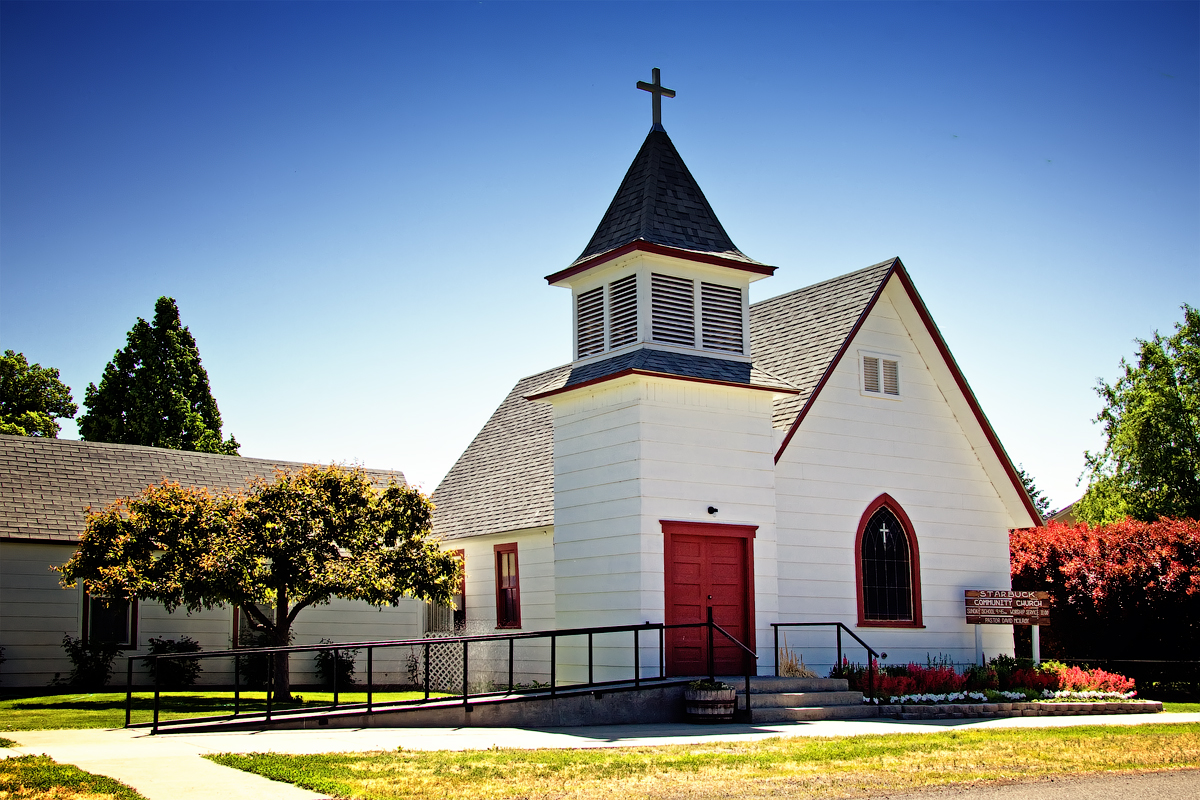
Sturbuck Community ChurchFaith and I love our church. We’ve been attending there for 6-7 months, since shortly after we moved to Wauconda. No church is perfect, but ours is a wonderful place. As we’ve gotten to know people there, they have welcomed us so graciously and generously. We were encouraged early-on to talk to the missions team about assistance in funding the trip and certainly to ask for prayer. We did, and they joyfully and generously responded … not just by officially sponsoring us, but with prayer, with encouragement, with interested questions, and with the personal contributions of loving, missions-minded brothers and sisters, even those who don’t know us terribly well yet. Another member, who is embarking on a long-term mission in June, and I are even being given the opportunity to share about our trips with the congregation. All up, it has been a huge blessing to be “sent” by my local church, and I suspect we’re just at the beginning of that. I look forward to sharing further and discussing more with them about the trip in the weeks and months ahead.

4) Pray and trust the Lord

Child Trusting FatherI suppose this goes without saying, but I’ll say it anyway. It’s clear to me that the success of fundraising for my trip has very little to do with how skillful I am at writing fundraising letters, the approach I take to “marketing” my trip, the fact that I’m blogging about it, the size of my church, the composition of my friend group, etc. Instead, it’s clear to me that it’s all about God’s being faithful to do what He wants to do … which is always right, and the highest good. It’s about prayer. It’s about trusting God to act. Yes, I worked hard and labored long to write a “good” letter, but my focus was more on glorifying God and testifying to His work than on establishing an air-tight, tremendously-compelling, unavoidably-persuasive case for why sending money was the spiritual and loyal (to me and God) thing to do. Or whatever. Our church is small. Our friends are not a bunch of millionaires. Our family isn’t exactly listed in Forbes. But God provided for this trip, as He has provided for everything else. And we never doubted that He would.

5) Check (or flat-out discard) your expectations

God didn’t do this the way I thought He would. I thought money would come in faster than it did. When I played the mental game about who I thought would do what, I was totally wrong. People I would never have guessed would send much money sent a lot, and people I thought would be a key contributor didn’t respond. A couple conversations at church went it directions I didn’t predict. I encountered negativity from places I didn’t expect and positive encouraging support from people I never dreamed would even notice I was going. In other words, God in His sovereignty does what He wants, and what He wants is always good. If I had gone into this guns-blazing with expectations that needed to be met in order for me to be happy, I’d have been anxious and miserable. Instead, glory to God!, our posture as a family was teachable and flexible, and that served us well.

My recommendation to anyone entering this process: Stand in awe of God proactively, before the first domino falls. Before you even start, resign yourself to the fact that you have NO idea what God is going to do, and then choose to be certain that when you see it (which might be long after the fact), that it’s going to be amazing!

I believe that I shall look upon the goodness of the Lord in the land of the living! Wait for the Lord; be strong, and let your heart take courage; wait for the Lord! (Psalm 27:13-14)


Images Credit:
1) Fireworks; Daily Hive
2) Letter writing; The Odyssey Online
3) Community church; Wikipedia
4) Trust; HPWP
Posted in Travel | Tagged , , , , | 3 Comments

Upgrading Eden

Garden of Eden

Preface

I recently facilitated a theology class at my church focused on the goodness of God entitled A God in Whom to Take Refuge. I’ve read and written quite a bit on this topic over the last couple of years, so it was very interesting (and a deep privilege) to provide leadership in a multi-week discussion on the topic.

Of course, one of the things we worked through at length in the class was God’s purpose in human suffering – how He uses it, why He allows it, how we should respond to Him in it, etc. I’ve written on this too, but as I was praying and preparing the materials for that particular week of class, God advanced some of my thinking about this topic beyond what I had previously written. And then, as if on cue, some people in the class challenged my thinking on a few points, forcing me to do even more work and research on the topic.

Specifically, in class, I made the statement that New Jerusalem (where the redeemed will live with God forever; see Revelation 21-22) will be superior to the Garden of Eden. I drew an explicit contrast between the two by calling Eden (before the fall) “sinless” and New Jerusalem “perfect.” This is the particular point my friends challenged, so I thought I would write down some of what I’ve been learning as I continue to read, study, and interact with God about it.

A few words about “perfection”

First, upon further reflection, I rather regret having used the word “perfect” to refer to heaven, New Jerusalem, or anything else but God Himself.

Associative Perfection

There is a sense in which everything God makes is “perfect” because God, who is Himself perfect, ensures the proper working out of all His plans and intentions (Psalm 115:3; 2 Chronicles 20:6; Job 42:2). I would call this a kind of “associative perfection,” meaning that all things associated with a truly perfect God are in some sense themselves “perfect.” But to be healthy, this view must focus more on how things will end up than on how they are. Whereas people and everything else in the universe are far from perfect in any sense now, God is sovereignly moving all the universe towards an end which we will declare is perfectly just and right and good (Romans 3:4). So in that sense, looking ahead to our ultimate end, I suppose we could call the world “perfect.” I don’t particularly like this approach, though, because I suspect it’s very hard to hold this view in balance. Instead, it seems likely to foster the temptation to excuse the brokenness we see in our world because of the goodness we imagine God will create out of it. For this reason, I’d rather consider the world to be “purposeful” or “destined to glorify God,” rather than “perfect.”

True- or Absolute Perfection

There is also a sense in which *only* God is perfect, because He is the defining standard and ultimate good by which everything right and just and beautiful in the universe is measured. Nothing can remotely be compared to Him. To show my hand right up front, my preference would be to reserve the word “perfect” only for this usage. God is perfect in holiness and beauty and glory and power and everything else for which we have categories of goodness … and no one and nothing else comes close.

Relative Finite Perfection

The term “perfect” might also be applied to people, if by it we mean to set up a comparison between, on the one hand, how we will be when we have been glorified in heaven and, on the other, any and all other possible states of humankind. So, in that sense, compared to any other “phase” or “season” or “state” of human existence throughout all of human history, including before the fall in the garden … compared to any of that, in heaven we will experience “perfect” human existence. This is how I used the term in class, and which I now regret.

Relative General Perfection

Lastly, if by “perfect” we mean “in comparison to anything else that can be imagined, including God himself,” then I don’t think the term can any longer be applied at all — not to people, regardless of how much sanctification or glorification we undergo, or anything else in creation. Once you include God in the set of things you are comparing (in general, a practice we shouldn’t get into — God is always alone in a set unto Himself, not truly comparable to anything or anyone else), then God is perfect and everything else is not. This returns us to our second category (true- or absolute perfection), in which God is perfect and everything else – whether Eden or heaven or angels or redeemed saints (whenever and wherever we are) – is not.

So, right out of the gate, in a discussion that compares and contrasts Eden with New Jerusalem, I would prefer to use terms like “fully realized” or “best possible” to describe New Jerusalem, rather than “perfect” … just to avoid confusion.

And speaking of that comparison, which is the point of this post, let’s dive in…

weak fallible manWhy did God make us fallible?

Have you ever wondered why God made Adam and Eve in such a way that it was possible for them to sin? As a younger Christian, I was pretty baffled by this, and the more people I talk to about it, the more I think many others are as well. On the surface it seems like God made Adam and Eve weak and breakable, and then (callously?) threw them in the deep end of the pool.

There they were in the garden, naked and blissfully ignorant of evil, camping right next to a big, beautiful tree full of juicy, shiny, red apples (who knows what was actually on the tree) which possessed the power, with a single bite, to destroy the world! AND God made them in such a way that they were able to decide for themselves, in all their frailty and (I’ll say it again) ignorance, whether or not to eat the apple. AND God had made a bunch of angels who broke bad and started a war against Him. AND He let the leader of all these wicked angels – the smartest, nastiest one of the bunch, mind you – take on the form of a serpent and slither around with Adam and Eve in the garden, tempting them to eat the apple. And to top it all off, at least as I read Genesis 1-3, it doesn’t really seem like God does much mentoring of the young couple about the many and varied reasons why they shouldn’t eat the apple. No seminars. No flannel graph lessons. No diagrams showing how thoroughly screwed up everything will be if they disobey. He just says “I command you not to do it!” and then seems to walk away, leaving them in their finitude and vulnerability to be tempted by Satan.

On the surface, this seems like a situation that can’t help but go horribly wrong. If we were watching this unfold in the first few scenes of a movie, we’d be pretty sure we could predict where it was all going by the time we got to Genesis 3:2. I suspect the movie version would seem a touch predictable. Some might even get bored and change the channel. And many of us, if we’re really honest, could say we’re tempted to consider God to be a bit negligent.

Was the fall of humankind part of God’s plan?

Edge of the ChasmDid God intend for Adam and Eve and their descendants to live in harmony with Him and with each other in the Garden of Eden forever? Well, yes, in the sense that Adam and Eve (therefore humankind) could theoretically have done so, if they had obeyed God. But they didn’t (and we wouldn’t have either), and before God created us or them or the first rays of light to separate the darkness, He knew they wouldn’t. When Adam and Eve defied God and ate the forbidden fruit, God was not in any sense surprised. I’ve heard so many people talk about that moment as if He were. They seem convinced that if we could somehow have seen “backstage” right after Adam and Eve ate the fruit, we would have found God shocked and shaken … crying in His Wheaties and madly scrambling to throw together a cosmic backup plan.

But this would imply all kinds of things that simply are not and cannot be true about God…

  1. That He was careless or incompetent or capricious, unknowingly or unfeelingly setting the first parents up for a fall when He put them in the garden. But the Bible is clear that God knows everything (e.g. Isaiah 40:13-14, 46:9-10; Hebrews 4:13) and loves us deeply (e.g. Proverbs 3:11-12; Exodus 34:6-7; Romans 5:8).
  2. Or that He was powerless to prevent their actions. But the Bible is clear that God is all-powerful (e.g. Psalm 147:5; Isaiah 44:24; Ephesians 1:18-23).
  3. Or maybe that He was blind to the possibility of human choices and/or out of control when Adam and Eve made them. But the Bible is clear that God intimately knew the number of my days (Job 14:5) and every choice I’d ever make (Psalm 139:1-6), even when I was still in my mother’s womb (Psalm 139:13-16).
  4. And on and on.

Unless we’re willing to disregard a whole lot of Scripture, I think we have to agree that God knew what Adam and Eve were going to do long before they did it. He knew what He was doing when He created humankind … exactly the way He created us. He didn’t accidentally or carelessly or sadistically overlook our weakness and ability to sin. I don’t think He made us hoping or intending that we’d be one way, only to have His purposes thwarted when we broke bad. The God of Scripture does everything with a purpose (e.g. Proverbs 16:4; Exodus 9:16; Philippians 2:13), and unfailingly accomplishes those purposes (e.g. Proverbs 19:21; Isaiah 14:24-27; Job 42:2). And I believe that includes the way He designed humankind from day one…

We are finite – we have to be, because that’s what it means to be created. All beings which are not God were created by God and are necessarily finite.

We are weak – because that’s another way of saying “finite.” Plus, this is clearly, vividly demonstrated when we in any sense compare ourselves to the Almighty God who made us.

We are able to sin – because we are made in the image of God … able to love, and therefore able to choose. And if we’re able to choose the right, we must accept that we are also able to choose the wrong.

Given these integral characteristics of humankind, I contend that the Fall becomes essentially inevitable. And God absolutely saw that coming. If He didn’t, how would He be, in any meaning sense, God?

Then why did He do it?

Wait a minute! If God is all powerful and predicted the rebellion of humankind – with all the horrors we have subsequently perpetrated on our fellow creatures throughout history – then why did He create us the way He did? Why did He set us up for a fall?

For years I’ve been giving the same answer to this question: “So that we could be with Him.” We can’t avoid finitude if we’re going to exist at all. How can God create another infinite being like Himself? That wouldn’t make any sense; it isn’t possible. Just as a square circle is not possible. It would make no sense. Any created being, by definition, must be finite, as we are. But also, being made to rationally and meaningfully and consequently choose means that we possess a fundamental prerequisite for meaningful relationship with Him. So, God made us in this way – in His image, able to choose – that it might be possible to intimately relate to Him. In other words, our finitude and our freedom of choice are integral to our existence. It couldn’t have been any other way, not if we’re going to fulfill the purpose, at any rate – which is to be sons and daughters of the Most High God. And that means we had to be “setup for a fall.”

To be finite and able to choose means to be fall-able (fallible).

The Rest of the Story

Paul HarveyBut there’s a deeper implication to this that God has been impressing upon me over the last few months. Yes, God created us and put us in the garden, but He did not intend for us to remain there. God created us to start in the garden, but then it was His plan for us to fall down so that He Himself might pick us back up again (1 Peter 5:10) … and set our feet upon a rock (Psalm 40:2). This wasn’t an accident or an oversight. It wasn’t a rebellion God failed to suppress. Satan didn’t get one past Him. And we don’t have to wonder if tomorrow something else might happen in the universe over which God doesn’t manage to retain control. Instead, we must face the difficult truth that we were made to be humbled so that we could then be exalted (c.f. Luke 14:7-11). In Eden, we were servants who tended the garden (Genesis 2:15) and named the animals (Genesis 2:19-20). But we failed to be good servants and got ourselves booted out of paradise. Now, in this world, we are strangers and aliens in a foreign land (1 Peter 2:11). But God is redeeming us. And someday in heaven – what Scripture calls “the holy city, the New Jerusalem” (Revelation 21:2) –, having been resurrected and glorified, we will be adopted sons and daughters (Ephesians 1:3-6). Then we will be what we cannot now imagine …  what we, frankly, couldn’t have imagined even if we had remained sinless in the Garden. In heaven, we will be true children, receiving our inheritance from our Father (1 Peter 1:3-5) and reigning with His Son (2 Timothy 2:10-13). We may have started this journey in a beautiful garden, but we will end it in the holy city, which is better by far.

This “journey narrative” should sound familiar. It’s the story of the prodigal son (Luke 15:11–32). It’s the story of the nation of Israel – in the exodus and the exile, and the promises of God which were fulfilled through and only after great suffering. And most importantly, it’s the story of Jesus (Philippians 2:1-11). It’s the story of my life – so often unable to humble myself, God in His love and mercy presses down on me until I cry out to Him to be rescued, and then He lifts me up. And then, when I look back, I realize I’m standing on a cliff far above where I started, looking down over a valley and grateful for all God has taught me by bringing me through it – down one side and up the other. The vertical gap between the plains far in the distance on the other side of the valley and my new lofty perch up on the next plateau is what Scripture calls “sanctification.”

And I don’t see it as a stretch to apply this pattern in general to redemption history. We see it throughout the Scriptures. It isn’t just Adam’s story or my story or Jesus’ story, it’s the story of the whole human race. This is the phenomenon that theologians have labeled “the two-fold pattern of redemption.”

Two-fold Pattern of Redemption

So, the Garden of Eden was good, but it wasn’t perfect. It was a good place for us to start, but God fully intended to improve us … to “perfect” us in the crucible of sin and brokenness and redemption. The garden was never God’s intended destination for humankind … even before the fall. It was the first step in a long, very well planned journey, ultimately leading to glory (Romans 8:29-30).

How can you say the Garden of Eden wasn’t perfect?

I’m glad you asked. There are several reasons actually…

Argument from language: Good vs. Perfect

The original languages in which Scriptures were written – the Old Testament in Hebrew and the New Testament in Greek – don’t support calling the Garden of Eden “perfect.” I’m certainly no expert in the Biblical languages, but I did do some research and can at least offer a layman’s perspective…

When God created the world, He called it “good,” not “perfect” (or equivalent). The Hebrew word used seven times in Genesis 1 to describe God’s work is טוֹב (“good”). There are other words translated “perfect,” such as תָּמִים (without blemish, complete, full, perfect, sound, undefiled, upright, whole) or תָּם (complete, pious, coupled together, perfect, plain, undefiled, upright) or כָּלִיל (whole, complete, full), etc. These words refer to things like the sacrifices to be brought to God (e.g. Leviticus 22:21), cities (e.g. Ezekiel 27:3-11), finishing tasks (e.g. throughout the book of Ezra), and of course to God Himself (e.g. Deuteronomy 32:4, 2 Samuel 22:31, etc). They are not used to describe Eden or God’s unfallen creation.

In Greek, there are also a few words that are typically translated “perfect,” but none of them are applied to the Garden of Eden. The adjective τέλειος is the primary Greek word for “perfect” in the Scriptures, occurring 48x in one form or another in the GNT (Greek New Testament) and 66x in the LXX (the Septuagint; the primary Greek translation of the Hebrew Old Testament, created in the 1st or 2nd century BC). When these terms are used, the vast majority of the time, they are translated “perfect” or “complete,” and refer to God Himself, to God’s will (e.g. Romans 12:2), to God’s expectation of our righteousness (e.g. Matthew 5:48), as an abstract concept of perfection (e.g. 1 Corinthians 13:10), etc. But to my knowledge, it is never used to describe Eden or human existence.

Admittedly, these words aren’t used in Scripture to describe heaven or New Jerusalem either. Neither are they used to describe us as people, fully redeemed or otherwise. But remember that we, who are saved in Christ are united with Him, and sanctified and ultimately glorified in Him. And He absolutely is perfect. So, when we share in His righteousness (see 2 Corinthians 5:21) and inheritance and glory (see Romans 8:12-17), we also share in His perfection. Therefore, by nature of an intimacy in New Jerusalem which will far surpass anything we’ve ever known in the church age, in the garden, or otherwise, we will become as close to “perfect” — as I said, I prefer terms like “complete” or “fully-realized” or “glorified” — as a finite human being can ever hope to be.

Taken all together, I see little justification in the language of Scripture for viewing the garden of Eden as “complete” or “perfect” … but rather as “good” (in Greek: καλός, meaning “beautiful, handsome, fine” or “someone, good, useful”; in Hebrew: טוֹב, meaning “merry, pleasant, desirable, pleasing, usable, beautiful, kind, etc.”). This supports the conclusion that there is not an equality between Eden and New Jerusalem. The former is “good,” but the latter is far better, more complete, glorified. Again, even about heaven I’d be hesitant to use the term “perfect.” And this disparity is inherent to the nature of these two places, not a result of the Fall.

The biblical language of perfection in Scripture is entirely oriented around “completeness” and “maturity” and the “end of a journey” (heaven), not its beginning (Eden).

Argument from Augustine: Able vs. Unable to Sin

Straight RoadIn the Garden before the Fall, according to the great 5th century theologian Augustine of Hippo, humankind was simultaneously “able to sin” (in the Latin, “posse peccare”) and “able to not sin” (posse non peccare). In New Jerusalem, we will still be “able to not sin” (posse non peccare) as we were in Eden, but also “unable to sin” (non posse peccare). This will be a totally new reality for us. Having been fully redeemed and reconciled to God, we will also fully realize the new nature we share with Christ. Anyone who has committed her life to the Lord has this nature, and is growing / being sanctified in this life. But not until God raises us to new life in heaven will we fully realize this new nature. And when we do, we will be “locked in” to our righteousness, in some respects similar to the angels, although this really isn’t the right comparison to make. It would be better to say that we will be united with Christ and share so totally in His nature that sin will be no more conceivable to us or within our reach than it is for God Himself. (Parenthetically, those in hell will be locked in to their depravity as well, in some respects similar to demons.)

This doesn’t mean that we become God, or even “gods.” It means we share in the nature of God as we were destined to; the flip-side of the coin which depicts Jesus, in the incarnation, taking on the nature of man. Nor does it mean that God will take away our freedom; rather, He will be fulfilling our destinies and our deepest desires as those who have “chosen sides” in this life. This isn’t a loss; it’s a gain. Not a suppression of freedom, but the ultimate, true freedom to be who we were made to be in the first place: children of the Living God. So, as residents of God’s holy city, we will enjoy the freedom to live sinless lives.

Now, contrast this with the first parents’ lives as a resident of Eden. They enjoyed freedom as well, the freedom to live in accordance with their nature. But that nature was such that they may or may not sin at any given moment, depending on how the mood struck them. In heaven, our new nature in Christ will be fully realized, and we will also be completely free to live according to it … always and only choosing what glorifies God. Put another way, we will always want only to do right, have the power to carry it out, and then will actually do it. No more conflict, internal or external. No more struggle. No more rebellion. Awesome!

It seems obvious to me that, if these are accurate portrayals of New Jerusalem and Old Eden, that I’d much rather have New Jerusalem. Wouldn’t you? And if so, then I think you’d agree with me that New Jerusalem is vastly superior to Old Eden. The τέλειος (perfection, completion, maturity, fulfillment) of our new natures, purchased by the blood of Christ, is vastly preferable to the inevitably-temporary, fundamentally-coincidental sinlessness Adam and Eve experienced in Eden.

Argument from vocational role: Workers vs. Family

Man GardeningIn the Garden of Eden, Adam and Eve were with God in a beautiful garden, and that sounds pretty great. But what kind of experience did they actually have? What kind of language is used in Scripture to describe their experience and their interactions with God in that place?

This is good and interesting and beautiful stuff, and no doubt Scripture paints a “luxurious” (what the word “Eden” means) picture of the garden. But I don’t think it’s the best stuff. Contrast this portrayal with how Scripture describes our being with God in New Jerusalem…

And I saw the holy city, new Jerusalem, coming down out of heaven from God, prepared as a bride adorned for her husband. And I heard a loud voice from the throne saying, “Behold, the dwelling place of God is with man. He will dwell with them, and they will be his people, and God himself will be with them as their God. He will wipe away every tear from their eyes, and death shall be no more, neither shall there be mourning, nor crying, nor pain anymore, for the former things have passed away.” (Revelation 21:2-4)

Or how about…

Blessed be the God and Father of our Lord Jesus Christ, who has blessed us in Christ with every spiritual blessing in the heavenly places, even as he chose us in him before the foundation of the world, that we should be holy and blameless before him. In love, he predestined us for adoption to himself as sons through Jesus Christ, according to the purpose of his will, to the praise of his glorious grace, with which he has blessed us in the Beloved. In him we have redemption through his blood, the forgiveness of our trespasses, according to the riches of his grace, which he lavished upon us, in all wisdom and insight making known to us the mystery of his will, according to his purpose, which he set forth in Christ as a plan for the fullness of time, to unite all things in him, things in heaven and things on earth.
(Ephesians 1:3-10)

I put it to you: Which experience do you want with God? What kind of relationship are you looking for? The Genesis 1-2 experience (created and well-cared-for servant) or the Revelations 21 / Ephesians 1 experience (beloved wife and adopted child)?

Argument from typology: Garden vs. Temple

Solomon's TempleNow fast forward a bit in Revelation 21…

And the one who spoke with me had a measuring rod of gold to measure the city and its gates and walls. The city lies foursquare, its length the same as its width. And he measured the city with his rod, 12,000 stadia. Its length and width and height are equal. (Revelation 21:15-16)

And I saw no temple in the city, for its temple is the Lord God the Almighty and the Lamb. And the city has no need of sun or moon to shine on it, for the glory of God gives it light, and its lamp is the Lamb. By its light will the nations walk, and the kings of the earth will bring their glory into it, and its gates will never be shut by day—and there will be no night there. They will bring into it the glory and the honor of the nations. But nothing unclean will ever enter it, nor anyone who does what is detestable or false, but only those who are written in the Lamb’s book of life. (Revelation 21:22ff)

Note that New Jerusalem is a cube and there is no temple. That’s interesting. Are these actual physical dimensions and descriptions of the buildings that will or won’t be on main street? I don’t know; maybe. But I would ask this instead: What’s the only other cube in the Bible? Give up? It’s the holy of holies in the tabernacle, then later in the temple in Jerusalem. For this reason, D. A. Carson sees this (TGC article | Interview with John Piper) as symbolically expressing that we will be united with Christ and dwell intimately with God in heaven forever. I tend to agree. The other language in Revelation supports this too. For example, there is no sun or moon, because God will directly be our light (Revelation 21:23), where there was definitely a sun and moon in Eden (Genesis 1:14-19). Or, consider that nothing unclean will ever be in heaven. This can’t be said to be true of Eden, because God permitted the serpent (who is Satan) to be there and to tempt Adam and Eve. Well, that and mosquitos, but I have no biblical reference to support that claim. Etc.

I know these are just a few examples, but I think they’re reasonably representative. And whatever else these differences mean, they are painting a picture in which we are much closer to God in heaven than the first parents were in Eden.

Conclusion / Putting it Together

Last Puzzle PieceMy intention is to make two points. First, the Garden of Eden wasn’t the best possible condition or context for humanity. It was a starting place, not a destination. And second, that God’s plan was from the beginning that humankind would fall and that He would redeem us.

Heaven will not be a return to Eden. It will be a serious upgrade … a whole new world … a final, intimate, best possible, all-surpassingly glorious, not-just-sinless place which God intended for His children from before the creation of the world (Ephesians 1:4). I don’t think God made a mistake or overlooked something or failed to get His way in the fall of humankind. I think, instead, that the fall was part of the plan … a means of “perfecting” us and this world in which we live … a plan to move us through humiliation and suffering to redemption and glory, not just to leave us in a beautiful garden.


Images and illustrations (in order of presentation):
1) Bill Looney in The True Account of Adam and Eve
2) Weakling, Information Age
3) Patrick Jager, How deep is your chasm?
4) Christian Examiner
5) Kirwin Narine, Straight Road 
6) Master Gardener
7) Solomon’s Temple
8) Missing Puzzle Piece, Cave Mamas
Posted in Theology | Tagged , , , , , , | 1 Comment

Limitless

boy-and-dad-pointing-49654347_m

Opening weekend of The Resurrection of Gavin Stone (Gavin Stone FB page) was last weekend. Our former church (Harvest Bible Chapel; see also Vertical Church Films) made the film to depict the Church as a place of 2nd chances, which is at the heart of the Gospel. I even participated in the making of the film (microscopic part, huge fun, big honor!).

The Resurrection of Gavin Stone

I went to see the movie with a group of friends on its 2nd night, and really enjoyed the movie. Definitely check it out! It dreams big dreams for the Church of Jesus Christ in a broader culture of individualism, isolationism, and consumerism. And it tells its tale masterfully. Cast is great. Story is great. Very funny. And edifying. I love that it would challenge pastors and churches to take the gospel more seriously. Maybe some critics, even Christians, will call it “cheesy” or doesn’t focus enough on God’s law, but I fear that might be more a (sad) commentary on our limited view of the gospel and the church in our day than it is of the movie or the people who made it. Go see it for yourself! I’d love to know what you think.

At any rate, very few things disappointed me about the movie, but one of them was that the Colton Dixon song Limitless ultimately did not make it into the final cut of the movie. It was featured in the official trailer, which is when I first heard it, but not in the movie itself. Sad panda!

But that didn’t keep me from buying the song the day I saw the trailer, and it doesn’t stop me now from writing a little bit about this song and its theology.

First, here are the lyrics…

Too young, too old, too shy, too bold
Too average, to make a difference
The world’s too big and you’re too small
If you try to fly, you’re gonna fall
They’re shouting, but we won’t listen

No more “impossible;” so much for “too difficult,” we know
That our God is greater
Oh, wake up you dreamers, become make-believers
This is who we are

We are limitless, limitless, limitless, limitless
The power of love, alive in us
Is limitless, limitless, unstoppable, and nothing less
No, nothing can hold us down
We’re limitless

Take away the limitations, when we fix our eyes on You
Flood our hearts with expectations
Lord, there’s nothing You can’t do

Doubt sees a mountain, no way around it
Faith sees a victory, no doubt about it
Fear sees a ceiling, hope sees the stars
Love be the light inside of our hearts

We are limitless, limitless, limitless, limitless
The power of love, alive in us
Is limitless, limitless, unstoppable, and nothing less
No, nothing can hold us down
We’re limitless
‘Cause You’re limitless

This is one of those songs that you need a solid theological foundation to rightly interpret. If you hear it, and it ratchets up your self-esteem a few notches — Look at me, aren’t I wonderful! Look at all this power my amazing humanness gives me to bring the rest of the world under my direct control! — then I’m pretty sure both Colton (wrote the song) and Dallas (made the movie) would strongly disagree. I certainly would.

This song, like so many others (whether they know it or not), is about Jesus — the primary, no-close-second lead role of history. Specifically, when I crank this song up way too loud for my teenage son’s taste, I’m not thinking about how amazing I am, but how amazing He is … and that I get to be in His story at all.

Gavin Stone PrayingFor the God of the universe to step into time in the person of Jesus of Nazareth, live a sinless life, and suffer death and separation from the Father that we might be brought into fellowship with Him and adopted into His family and sit beside Him in His throne room … Well, cheesy or not, what’s “limitless” here is my astonishment. God is clearly entirely irrational. Guess that’s what love does.

But given that He has been moved to action by His amazing grace, rescued me from the Kingdom of darkness, and transferred me into the Kingdom of His beloved Son (Col 1:13), I have to grapple with the fact that God has done so for a reason. He created me for a reason. He sends me out for a reason. He gives me His Spirit for a reason.

And the limitless God of limitless purposes and power has indwelled those who are united with Christ by His limitless Spirit … making the scope of our lives, yes that’s right, limitless. “The power of love, alive in us, is limitless — unstoppable and nothing less.” If you belong to Christ, then the same power that raised Jesus from the dead now lives in you! (one of several messages of Rom 8:11).

As you might have guessed from the highlighting, my favorite lines in the song comprise the bridge, which brilliantly contrasts doubt, faith, fear and love.

Doubt sees a mountain, no way around it
Faith sees a victory, no doubt about it
Fear sees a ceiling, hope sees the stars
Love be the light inside of our hearts

The power of the Spirit should be increasingly moving the fixation of our minds and hearts and hands from doubt (What if I can’t?) to faith (We am more than conquerers! Romans 8:1), from fear (What if I fail?) to love (Father, all that matters is that I’m with you; you do the rest! John 15:16-17). And I assure you, by the authority of God’s Word, that the love of God which gives you live and indwells you by faith, is sufficient to accomplish the purposes for which God created you, me, this song, this movie, and the lives of every person involved in all of them. (Isaiah 55:6-11)

Gavin Stone LimitlessI know the movie isn’t grossing as much as Dallas and the team would like (go see it!), but my encouragement would be that God controls the market that returns on the investment of our talents. Our failure is only in choosing not to invest (Matthew 25:14-30). Be patient, pray, trust, and wait to see what the Lord does. God fights for us battles we can’t even understand, let alone fight for ourselves!

I also know many Christians who have essentially divested their lives of Christian music, as well as those who dismiss movies like Gavin Stone out of hand (along with many other excellent Christian films made in the last few years) on the assumption that they must inevitably be cheesy or trite or poorly acted or whatever. But I disagree, and so does God. I don’t really have an opinion so much on how “cheesy” (or whatever) it is — for my part, I actually quite enjoyed it — but isn’t that entirely personal preference anyway … driven almost exclusive by the culture we’re imbibing? Do those opinions say more about the movie and the music, or about us? Honestly, I wasn’t grading it, I was praising God for it and asking God to make me more like Him, as the movie depicts that transformation. Same for Colton’s song.

Bottom line, what I know is this… In this movie and in this song, the Word of God goes out, and it will not return to the eternal God having failed to accomplish everything that He intended for it to accomplish. And He is drawing His people into that adventure.

This is what Dallas demonstrates in the life of the character Gavin Stone. This is what Colton Dixon sings about. And this is what God dreams over your life.

The possibilities are limitless! I hope we don’t miss them.


Photo credit: main image, 123rf.com sideInikov; others, Vertical Church Films
Posted in Psalms, Music and Worship, Real Life, Theology | Tagged , , , , , | 1 Comment