Mount of the Beatitudes

Mount of the Beatitudes

After another olive oil soaked breakfast, we made our way to the Mount of the Beatitudes to a spot near where Jesus is believed to have delivered the Sermon on the Mount. There is of course a church built there to commemorate this. It is the shape of an octagon, one side for each of the beatitudes. The grounds around it are beautifully kept. But what bothered me, like many of the commemorative churches, was the overpriced gift shop and refreshment areas, turning what would otherwise be a beautiful monument to Jesus’ great sermon into a place of business.

At any rate, the entire large group gathered in a little amphitheater built for groups like us to gather. Lindsay McCaul led worship. James assembled each of the pastors in our group from around the country and their wives, and each read a part of the Sermon on the Mount from Matthew 5-7. James then preached on the last few verses in chapter 7 where Jesus talks about the difference between building your house on the sand vs the rock.

I just love James. He walked through the text in his customary expository style, his delivery brimming with the expectation that we would actually apply the Word to our lives, not just listen to a message. And not only that, he managed to take a very familiar passage and introduce me to a new thought in teaching it. His point was that the man who builds his house on the sand looks pretty smart for a while. In fact, if troubles never come, then you’d rather be the sand guy. How much quicker and easier would it be to build on sand!? You’d be grilling burgers on the deck with your friends while the man building on the rock was still digging foundation.

Building your house on the rock only makes sense if troubles are going to come. But that’s the whole point: troubles always come. And even if you live a life of luxury and privilege in this world, the ultimate “trouble” awaits you: How will you answer a holy God who rightly demands that you give an account for your life? In this day of trouble, the sand will not provide adequate foundation to withstand the wind and the rain.

So James asked us (always moving toward application), “What would it look like for you to build your house on the rock?” At first blush, I didn’t know. Lately, I’ve been far too focused on answering questions like this in terms of career or geography or possessions. But man’s life simply doesn’t consist of the abundance of these things.

After James had finished his message, I walked down to the edge of the water — well, as close as I could with a banana plantation in the way that wasn’t there in the 1st century — and asked God to reveal to me the answer to James’ question. What I felt is that the answer isn’t about “what”, it’s about “how”. It’s not about what I do or what my address is or what I own, it’s about how I work and how I live and how I love others. Of course, this stuff requires time and margin and focus and discipline and intentional investment, but millions of people with every job, house, mortgage, car and salary imaginable both do these things well and do them poorly. It’s a matter of the heart, of belief, of a willingness to learn and rely on God’s promises, and on minimizing distraction.

So, I was grateful to God for that word. I’m pretty dense, so I’m still working through all of it. But I get absolutely stoked that God loves me so much, and I’m grateful for the freedom He gives and the way He takes care of me all the time.

Fantastic morning on the seashore.

Posted in Bible Stories, Theology, Travel | Tagged , , , , , , , | Leave a comment

On the Sea of Galilee

Sea of Galilee

I’ve heard a couple people say that the trip just keeps getting better, and they’re right. Absolutely my favorite experience to-date is this next part. From Capernaum, we drove a short distance along the coast to the site of where a group of archeologists had unearthed a 2000 year old boat, similar to the kind Jesus used to sail about on the Sea of Galilee. It was accidentally, and it was a major feet of engineering genius to dig it out, move it, bath it in protective chemicals, place it in a stainless steel exoskeleton, and display it to the general public. A very interesting museum had been erected at the site to tell the story and display the boat. It was fascinating.

After reading all about it and doing a little shopping in the gift shop, we were herded out onto the dock to board our own 1st century replica ship to cruise across the lake back to our hotel in Tiberius. Being on the boat has been my favorite part of the trip so far.

First, we tethered three boats together, which was an adventure all in itself. I’m not really sure they were designed to do that. Actually, we had the first two boats together from the point of launch, and had to wait for the third to join us. This wasn’t in the plan, and there was some impatience over it, but it turned out to be pretty sweet in my opinion, because it gave us time for pictures and additional worship.

James, Kathy, Lindsay, and Abby recorded a video at the bow of the ship which I thought was really cool. That was also a pretty choice place for pictures, with the sun setting in the background. I enjoyed serving people by taking pictures of them together (it’s so easy to only have one of you in every picture when you vacation as a couple).

When the worship music broke out, that’s when I really started getting into it. It was pretty amazing to be out in the middle of the Sea of Galilee in a wooden boat worshipping God, knowing that the music was echoing across the lake the way Jesus’ voice had reached thousands on the shore millennia ago. I also greatly enjoyed watching the people there, knowing that they were each having a similar experience. Everyone interacted with the experience in their own personal way, which is such a picture of the church. One God, one holy place, many people, many experiences, many pathways to relate to God.

After Lindsay led worship, James preached on Matthew 14, when Jesus sent the disciples ahead of him on a boat out onto the Sea of Galilee, knowing that there would be a terrific storm. Caught out on the lake as the wind and waters raged against the boat, the disciples were afraid for their lives, fighting against the storm. In the middle of the night, Jesus walked out to them on the water, and they were terrified because they thought He was a ghost. He calls to them, Peter (the impetuous one that he is) asks Jesus to call to him to walk out on the water. Jesus does, and Peter with great faith jumps out of the boat and miraculously walks on the water to Jesus. But of course, as we do, he takes his eyes of Jesus, becomes afraid, and begins to sink. Jesus rescues him, and the disciples rightly worship Him.

James’ devotion on this passage focused on how Jesus orchestrated the whole thing to demostrate His faithfulness both to the disciples and to us, and that our role in the picture is to A) fix our eyes on Jesus and B) to jump out of the boat. Even if we sink, Jesus will be there to catch us. A classic message from this passage, but made more alive hearing it echo across the waters of the Sea of Galilee.

Before, during and after the message, it was beautiful to look out over the water and see the surrounding mountains, knowing that tens of thousands had sat on the shores of this lake to hear Jesus teach. The sunset was beautiful. After dark, the city of Tiberius was beautiful, lit up on the hillside. It reminded me of Jesus’ words in Matthew 6 that a city on a hill cannot be hidden.

Another great part of the ride was when one of the Israelis led us in a gospel song. Everyone got extremely rowdy, clapping and dancing, and it was great fun. Certainly unlike any other boatride I’ve ever taken. There was also a point when James and his daughter Abby danced together during the music. He both plays and devotes himself to the gospel and to his family with such reckless abandon, even in the presence of so many that are inclined to judge him or hold him to an impossible standard.

Posted in Travel | Tagged , , , , | 3 Comments

Capernaum, Jesus’ Adult Home

Capernaum

After lunch, we back around to the northern end of the Sea of Galilee to visit Capernaum. One of the things I have definitely been finding disturbing is that every place Jesus did anything significant in Israel now has a church, gift shop, and parking lot built on top of or next to it. Their version of being respectful and keeping the site holy is to require everyone to cover their shoulders and knees when we visit the site, but I’d much rather they forewent building something on top of the site and selling Coke for $3 a can. But when it really turns my crank is when they offer little urns of dirt or bottles of water that’s supposedly blessed because it came from that site. Ugh. I don’t see Jesus being happy about all that.

But anyway… We visited the site of Capernaum. There’s nothing there now, but in Jesus’ day it was a thriving fishing village on the north end of the Sea of Galilee. Peter lived there before he was called to be an apostle, and it is probable that Jesus stayed in Peter’s home often, using it as a home base for his ministry in the Galilean region.

There is of course a church there, along with the ruins of ancient Canaanite temple, covered over by Jewish synagogues and pagan temples (read 1 and 2 Kings), covered over by a church (the Constantine era), covered by a masque (the Byzantine era), etc. So lots of layers and ruins and fun for archeologists. By the way, evidently Jesus did quite a few miracles in the synagogue that existed on this site in His day. Remember how Jesus condemned Capernaum in Matthew 11:23-24? “And you, Capernaum, will you be exalted to heaven? You will be brought down to Hades. For if the mighty works done in you had been done in Sodom, it would have remained until this day. But I tell you that it will be more tolerable on the day of judgment for the land of Sodom than for you.”

One thing I found interesting was that the new church built over the site of what was thought to be Peter’s home looked like the flying saucer from the movie Chicken Little. It has legs which suspend an octagonal spaceship-looking building over the archeological dig site. Weird. We later learned that the eight sides are significant because they represent the eight beatitudes with which Jesus opens the sermon on the mount in Matthew 5.

Posted in Bible Stories, Theology, Travel | Tagged , , , , , , | Leave a comment

Fish Heads at Ein Gev

After our detour in the Golan Heights, we headed south along the east side of the Sea of Galilee to a little port village of Ein Gev, maybe 2/3 of the way down the lake. This was a place that served “Peter’s fish”, we were told. We were also warned that it would be served the way Peter would have eaten it to. So, when I got there, I discovered what this meant… The default order at this restaurant was a whole tilapia. Head. Tail. Bones. The whole deal. Plus a bunch of sides and salads served family style. Of course, that included pita and humus. (What doesn’t in Israel?!) However, if you felt you couldn’t handle the “Peter Special”, then you could get the head and/or tail removed in the kitchen, or just get fillets (which would be frozen not fresh), or even order a burger or pizza if you really couldn’t take it.

My philosophy… When in Israel, do like Peter did. Plus, the Philippines had numbed my senses. So I’m the only person I know of that ordered the default. And it came out whole, starring at me, and soaked in oil. Normally I like Tilapia, but I’m used to eating it grilled with mango chutney (long live Bone Fish Grill). But if pita and humus comes with every meal in Israel, then oil comes with every dish served at every meal. Sometimes I’m surprised I don’t see people walking around drinking the olive oil out of a glass.

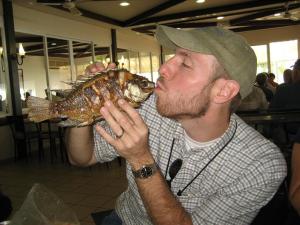
So, I was once again the party guy. Everyone wanted pictures of my whole fish. A guy at my table, pretended to bite the head off his already-decapitated fish for a classic picture pose. I couldn’t be left totally out in the cold without a clever picture, so even though it was a distant second, I posed for cameras kissing mine. Yes, the fish. We made a cute couple. Here’s a picture…

Kissing Peter's Fish ... before I ate it

After doing my traditionally poor job of cleaning the bones of my dinner and supplementing it with 3 massive pieces of pita slathered with humus, we were back on the road heading for Capernaum.

Fish heads, fish heads, rolly polly fish heads……..

Posted in Food, Fun and Games, Travel | Tagged , , , , | Leave a comment

In the Golan Heights, on the border between Israel and Syria

Golan Heights

We took a short detour on our way back to the Sea of Galilee (where we’d spend the rest of the day) to get a better view of the Golan Heights and the Syrian border. We stopped at a produce stand, where I purchased some local Olive Oil (which I hope holds up to the pressures of the cargo hold of a 777 during a transatlantic flight). While there, our tour guide gave us all manner of details about the Six Days war in 1967 and the general conflict that Israel has experienced with it’s neighbors to the north and east (Lebanon and Syria) over the years.

We learned about the conflict that had occurred in 1973 between Israel and Syria. The United Nations, assisted by the Nixon white house (Henry Kissinger), brokered a cease fire agreement. The deal was that Israel and Syria would symmetrically deploy troops and tanks to either side of the border the same distance apart. The UN then placed listening stations along the border on each side and built an administrative facility in one of the small valleys near the border in the Golan Heights, a mile or so off the main road that connects the junction in the Europe-Africa Intercontinental Bridge (also called the Via Mares, or “the Way of the Sea”) at Tel Megiddo and Damascus, capital of Syria. It’s amazing to see how close all these places are to each other and how strategic the various land positions and resources are. When you add the religious tensions, no wonder there is so much conflict in this region!

In addition to the UN listening posts, we also saw several military bases and other installations both where we were on the Israeli side and as we looked out across the valley at the Syrian side. Our tour guide told a really interesting story about an Israeli spy who had infiltrated the ranks of the Syrians before the 1973 conflict. Evidently the Syrians tried to copy a lot of things the Israeli’s do, and this spy convinced their military leadership to plant beautiful eucalyptus trees (which the Syrians liked but which only grew in Israel) around their military bases to camouflage them. But of course, he was leaking information to the Israeli army, so they immediately knew that wherever they saw eucalyptus trees there was a military base. So, that was as good as painting targets for Israel’s bombers when the war started. Isn’t that the kind of thing you only read in cartoons?

Another interesting fact that served as a fairly stern reality check. Evidently, there are areas of the Golan Heights that still have mines in them. Uh … not cool … staying on the bus.

BTW, our tour guide obviously has no love at all for the UN, and neither do many of the other guides, as I understand it. However, he loved the United States, and claims that most Israelis do too. Makes sense, but it’s nice to hear. I think it’s also important to point out that the instruction / information we were receiving with regard to these conflicts and the motives behind them were distinctly Israeli. Nowhere in this picture is anyone expecting to get an unbiased view.

Posted in Bible Stories, Military, News, Politics and Culture, Travel | Tagged , , , , , | Leave a comment

Caesarea Philippi

Caesarea Philippi

From Tel Dan, we headed east just a few miles to Caesarea Philippi – founded by Philip, one of the three sons of Herod the Great during the time Jesus walked the earth. Since then, it has been renamed Banius (after the Greek god “Pan”, but there was no “P” in the (I think it was) Arabic language, so they changed it to “B”).

Just outside Caesarea Philippi is the site of the second fountainhead of the Jordan river. A large rock face exists halfway up Mount Hermon, in the northern region of the Golan Heights. There, out of a large cave/opening in the rock face, flows a fresh water stream which feeds the Jordan. Beneath this cave is the largest underground fresh water reservoir in all of Israel. Yet again a good reason to not want to surrender this strategic territory.

Philip, being a fan of multitheism and Pan in particular (can’t remember what he’s a god of), also wanted to create a multi-cultural temple of sorts with a place for all manner of foreign gods. So, even today, if you visit the base of the rock face near Caesarea Philippi, you can see indentations in the rock wall. In Jesus’ day, each would have been home to a bust or figurine or other statue representing a false god. At one point during his ministry, Jesus took his disciples on a 30+ mile trip from Capernaum (home base to him for much of his ministry life) to Caesarea Philippi to teach them at the base of this cliff.

You can read about it in Matthew 16. Jesus walked boldly into one of the very centers of paganism at the time, and boldly asked the disciples who they thought He was. Peter answered correctly that Jesus is the Christ, the Son of the Living God.

While we were there, James taught on this passage in a powerful way, calling us to make the decision who Jesus is in our lives and then live like it. It was his first time he was with us as a group, having arrived late the night before from speaking at a marriage conference in California. Lindsay McCaul was also there leading worship, which I greatly enjoyed. I felt like I was one of the few in the audience who was also a musical leader, so I was helping to guide the group from within the audience. Especially since Lindsay didn’t have a mic.

The experience at Caesarea Philippi really was a powerful and interesting one. In fact it was James’ description of this setting and the impact it had on him when he came to Israel the first time last year that first got me thinking about wanting to go to Israel myself. If only Faith were with me.

Posted in Bible Stories, Military, News, Politics and Culture, Theology, Travel | Tagged , , , , , , , | 1 Comment